
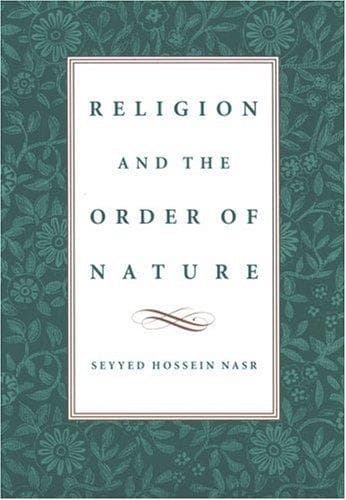
Religion and the Order of Nature
الدين ونظام الطبيعة
La religion et l'ordre de la nature
Editorial summary
Seyyed Hossein Nasr's Religion and the Order of Nature presents a comprehensive critique of modern scientific materialism and its consequences for understanding nature, while advancing a traditionalist religious perspective rooted in perennial philosophy. The work argues that the contemporary environmental crisis stems fundamentally from the desacralization of nature that occurred during the Scientific Revolution and Enlightenment, when the West abandoned its traditional religious cosmology in favor of a mechanistic worldview that views nature as mere matter devoid of spiritual significance.
Nasr contends that the modern scientific paradigm, by reducing nature to quantifiable physical processes, has severed the metaphysical connection between the natural world and its divine source. This rupture, he maintains, not only impoverishes human understanding but directly enables the exploitation and destruction of the environment. Against this reductionist framework, Nasr advocates for a recovery of traditional religious perspectives—particularly drawing from Islamic, Christian, Hindu, and other sacred traditions—that recognize nature as a divine theophany bearing inherent sacred meaning.
The work engages critically with both secular environmentalism and liberal religious responses to ecological issues, arguing that these approaches remain trapped within modernist assumptions and thus cannot address the root spiritual causes of environmental degradation. Nasr particularly challenges process theology and evolutionary spiritualities, contending that they compromise essential metaphysical principles by accommodating modern scientific materialism. Instead, he promotes a traditionalist metaphysics that affirms God's absolute transcendence while recognizing divine immanence through nature's symbolic and sacramental character.
Methodologically, Nasr employs comparative religious analysis alongside philosophical critique, drawing extensively from Islamic philosophy, Christian mysticism, and Eastern traditions to construct his argument. His intellectual framework derives from the perennialist school associated with René Guénon and Frithjof Schuon, which posits an underlying metaphysical unity beneath diverse religious expressions.
The work's significance for the God debate lies in its sophisticated articulation of how different conceptions of divinity necessarily entail different relationships with nature. Nasr demonstrates that the question of God's existence and nature cannot be separated from cosmology and environmental ethics. By linking the ecological crisis to the rejection of traditional theism, he offers a distinctive critique of secular modernity while proposing that authentic environmental healing requires recovering a sacred vision of nature grounded in traditional religious metaphysics.
Argument formulations engaged
Related works
Nasr, Seyyed Hossein (1996). Religion and the Order of Nature. Oxford University Press, USA.
@book{religion-and-the-order-of-nature-1996,
  author    = {Nasr, Seyyed Hossein},
  title     = {Religion and the Order of Nature},
  year      = {1996},
  publisher = {Oxford University Press, USA},
  url       = {https://god-database.com/en/works/religion-and-the-order-of-nature-1996}
}