
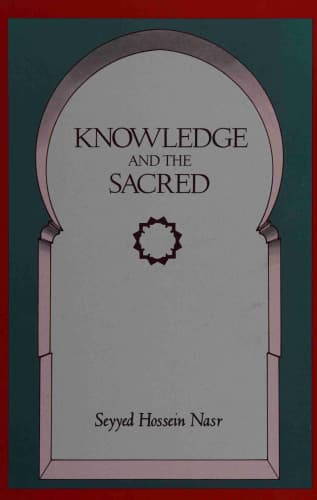
Knowledge and the Sacred
المعرفة والمقدس
Connaissance et sacré
Editorial summary
Seyyed Hossein Nasr's Knowledge and the Sacred presents a comprehensive critique of modernity's epistemological foundations while arguing for the recovery of sacred knowledge as essential to authentic human understanding. This work, originally delivered as the 1981 Gifford Lectures, positions itself against the secular rationalism that has dominated Western thought since the Enlightenment, proposing instead that true knowledge must be rooted in divine revelation and spiritual intuition.
Nasr develops his argument through a systematic examination of traditional metaphysics across various religious civilizations, particularly drawing from Islamic philosophy, Hindu Vedanta, and Christian mysticism. He contends that modern Western philosophy's separation of knowledge from the sacred represents not progress but a fundamental deviation from humanity's primordial wisdom. The work traces how this desacralization of knowledge has led to what Nasr identifies as the spiritual crisis of contemporary civilization, where scientific materialism cannot address ultimate questions of meaning and purpose.
Central to Nasr's methodology is his deployment of the perennialist philosophy associated with René Guénon and Frithjof Schuon. He argues that beneath the diversity of religious forms lies a transcendent unity of sacred knowledge, accessible through intellectual intuition rather than discursive reason alone. This approach allows him to present a unified front of traditional wisdom against modern secularism while maintaining respect for religious plurality.
The work engages critically with major figures in Western philosophy, particularly those Nasr sees as responsible for the progressive secularization of knowledge: Descartes, Kant, and the logical positivists. He argues that their reduction of valid knowledge to empirical and rational categories excludes the most significant dimension of reality—the sacred. Against this reductionism, Nasr advocates for a hierarchical understanding of knowledge where intellectual intuition, grounded in divine illumination, stands above both sensory perception and rational discourse.
Nasr's contribution to the God debate lies in his sophisticated articulation of how traditional metaphysics provides not merely religious belief but a complete epistemological framework that includes and transcends modern scientific knowledge. His work challenges the assumption that secularization represents intellectual maturity, arguing instead that the abandonment of sacred knowledge impoverishes human understanding. This perspective offers a substantive alternative to both fundamentalist rejection of modernity and liberal accommodation to secular frameworks, proposing instead a renewal of traditional wisdom that can engage contemporary challenges while maintaining fidelity to transcendent truth.
Argument formulations engaged
Related works
Nasr, Seyyed Hossein (1981). Knowledge and the Sacred.
@book{knowledge-and-the-sacred-1981,
  author    = {Nasr, Seyyed Hossein},
  title     = {Knowledge and the Sacred},
  year      = {1981},
  url       = {https://god-database.com/en/works/knowledge-and-the-sacred-1981}
}