
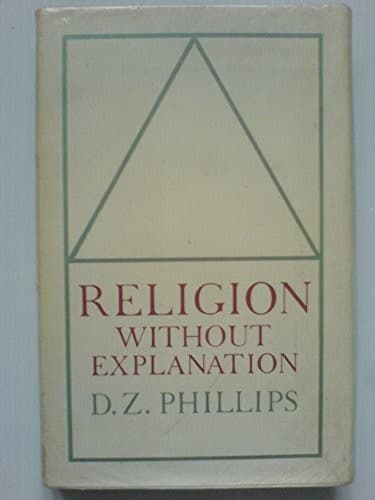
Religion Without Explanation
الدين بلا تفسير
Religion sans explication
Editorial summary
This monograph presents a sustained critique of explanatory approaches to religious belief, arguing that attempts to explain religion through causal theories fundamentally misunderstand its nature. Phillips challenges both reductionist accounts that explain religion away and philosophical defenses that treat religious belief as a hypothesis about reality requiring justification. His central thesis maintains that religion constitutes a distinctive form of life with its own internal logic, one that cannot be adequately understood through external explanatory frameworks.
The work systematically examines various explanatory strategies employed by anthropologists, sociologists, psychologists, and philosophers. Phillips demonstrates how functionalist accounts reduce religion to its social utility, while psychoanalytic interpretations treat it as wish-fulfillment or neurosis. He argues these approaches share a common error: they assume religious beliefs require explanation in terms of something more fundamental, whether social cohesion, psychological needs, or metaphysical hypotheses. Against this view, Phillips contends that religious language and practice possess their own grammar that must be understood from within the religious form of life itself.
Drawing extensively on Wittgenstein's later philosophy, Phillips develops his alternative conception through careful attention to actual religious discourse. He shows how religious believers' talk of God, prayer, immortality, and divine action operates according to different logical criteria than empirical or theoretical statements. When believers speak of God's reality, they are not positing an explanatory hypothesis but expressing a fundamental orientation toward existence. Prayer represents not causal intervention but a practice of self-examination and spiritual discipline. Religious concepts gain their meaning through their role in believers' lives rather than through reference to metaphysical facts.
The monograph's significance lies in its rigorous application of Wittgensteinian insights to philosophy of religion, offering a third way between crude reductionism and traditional natural theology. Phillips rejects both atheistic debunking and theistic apologetics as misguided enterprises that share false assumptions about religion's explanatory function. His approach influenced subsequent non-realist interpretations of religious language while drawing criticism from realists who argue he evacuates religion of its truth claims. The work remains controversial for its radical reconceptualization of what religious belief involves, challenging conventional frameworks for understanding the rationality and reality of religious commitment.
Argument formulations engaged
Related works
Phillips, Dewi Zephaniah (1976). Religion Without Explanation. Blackwell.
@book{religion-without-explanation-1976,
  author    = {Phillips, Dewi Zephaniah},
  title     = {Religion Without Explanation},
  year      = {1976},
  publisher = {Blackwell},
  url       = {https://god-database.com/en/works/religion-without-explanation-1976}
}