
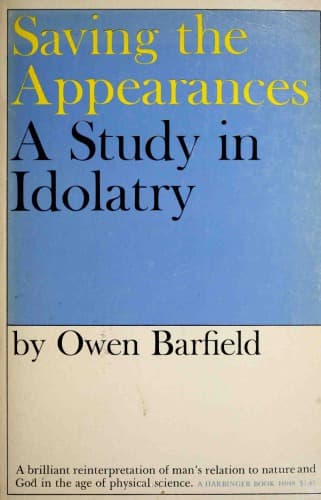
Saving the Appearances: A Study in Idolatry
إنقاذ المظاهر: دراسة في عبادة الأوثان
Sauver les apparences : une étude sur l'idolâtrie
Editorial summary
This study presents a distinctive philosophical anthropology examining the evolution of human consciousness through changing relationships with divine reality. Owen Barfield argues that modern Western thought suffers from a fundamental misunderstanding of perception and reality, which he terms "idolatry" - the mistake of treating appearances as independent, self-subsistent entities divorced from consciousness and divine participation.
The work traces three major epochs in human consciousness. In the first, "original participation," ancient peoples experienced phenomena as direct manifestations of divine presence, perceiving nature as ensouled and meaningful. Medieval consciousness maintained a modified participation through symbolic thinking, where appearances pointed beyond themselves to spiritual realities. The scientific revolution initiated "non-participation," treating the phenomenal world as purely material and mechanistic, severing the perceived connection between appearances and consciousness.
Barfield critiques both scientific materialism and religious fundamentalism as forms of idolatry that mistake representations for reality itself. Against positivist assumptions that primitive animism represents mere projection onto neutral matter, he argues that earlier consciousness genuinely participated in a divinely saturated cosmos. The modern isolation of subject from object, mind from matter, represents not intellectual progress but a contraction of awareness that renders both God and meaning problematic.
The author's method combines philological analysis with philosophical speculation, drawing on Romantic philosophy, particularly Coleridge, and anthroposophical insights from Rudolf Steiner. He examines how language evolution reveals consciousness transformation, demonstrating that metaphorical meanings preceded literal ones, suggesting that spiritual perception historically preceded material abstraction.
The work's significance for the God debate lies in reframing the question entirely. Rather than asking whether God exists as an object among objects, Barfield explores how different modes of consciousness determine what can appear as real. He suggests that recovering "final participation" - a conscious co-creation with divine imagination - offers a path beyond both naive realism and skeptical materialism.
This contribution challenges standard narratives of secularization as intellectual maturation, proposing instead that modernity's God-problem stems from an impoverished phenomenology. By reconnecting consciousness, cosmos, and divinity through participatory knowing, Barfield opens theological possibilities foreclosed by subject-object dualism, influencing subsequent thinkers in theology, ecological philosophy, and consciousness studies.
Argument formulations engaged
Related works
Barfield, Owen (1957). Saving the Appearances: A Study in Idolatry.
@book{saving-the-appearances-a-study-in-idolat,
  author    = {Barfield, Owen},
  title     = {Saving the Appearances: A Study in Idolatry},
  year      = {1957},
  url       = {https://god-database.com/en/works/saving-the-appearances-a-study-in-idolatry-1957}
}