
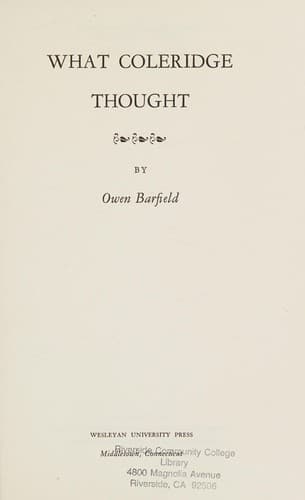
What Coleridge Thought
ما فكر فيه كولريدج
Ce que Pensait Coleridge
Editorial summary
This monograph presents a comprehensive examination of Samuel Taylor Coleridge's philosophical and theological system, arguing that his thought represents a coherent metaphysical vision centered on the dynamic relationship between consciousness and divine reality. Barfield contends that Coleridge developed a sophisticated understanding of human participation in divine creative activity through the imagination, positioning him as a crucial figure in post-Kantian attempts to overcome the subject-object dichotomy while maintaining meaningful discourse about God.
The work traces Coleridge's intellectual development from his early Unitarian phase through his engagement with German idealism, particularly Kant and Schelling, to his mature position articulating a participatory metaphysics grounded in Christian Platonism. Barfield demonstrates how Coleridge rejected both mechanistic materialism and subjective idealism, developing instead a polar logic that understands reality as constituted by dynamic tensions between opposing forces held in creative unity by divine will. This framework enables Coleridge to conceive of God not as a static absolute but as living act, perpetually manifesting through the interplay of infinite and finite, unity and multiplicity.
Central to Barfield's interpretation is Coleridge's distinction between primary and secondary imagination, which grounds human creative activity in divine creativity itself. The primary imagination represents humanity's fundamental participation in the divine act of perception that continuously creates the phenomenal world, while secondary imagination involves conscious artistic creation that mirrors divine creative activity. This theory positions human consciousness as inherently theological, suggesting that authentic knowledge requires recognizing our participation in divine knowing rather than attempting to observe reality from an impossible neutral standpoint.
The monograph situates Coleridge's contribution within broader debates about religious language and experience in modernity. Barfield argues that Coleridge anticipated twentieth-century concerns about the viability of theological discourse after Kant by developing a participatory epistemology that grounds religious claims in the structure of consciousness itself rather than in external proofs or mere subjective feeling. This approach offers resources for understanding religious experience as cognitive while avoiding both fundamentalist literalism and reductive naturalism.
Barfield's study illuminates how Coleridge's philosophical theology provides a distinctive response to modern critiques of religious knowledge, proposing that human creative imagination serves as the proper organ for apprehending divine reality. This positions Coleridge's thought as particularly relevant for contemporary discussions about consciousness, meaning, and the possibility of theological knowledge in a scientific age.
Argument formulations engaged
Related works
Barfield, Owen (1971). What Coleridge Thought. Wesleyan University Press.
@book{what-coleridge-thought-1971,
  author    = {Barfield, Owen},
  title     = {What Coleridge Thought},
  year      = {1971},
  publisher = {Wesleyan University Press},
  url       = {https://god-database.com/en/works/what-coleridge-thought-1971}
}