
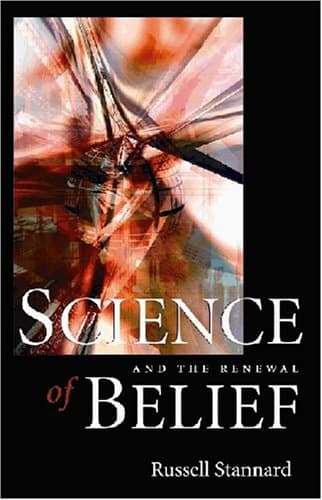
Science and the renewal of Belief
العلم وتجديد الإيمان
La science et le renouveau de la croyance
Modern science, far from undermining religious belief, provides renewed grounds for theism by revealing a universe whose order, intelligibility, and fine-tuning point toward a transcendent source.
Editorial summary
Russell Stannard's "Science and the Renewal of Belief" represents a significant contribution to the science-religion dialogue of the early 1980s, arguing that contemporary physics, far from undermining religious belief, actually provides new grounds for theistic conviction. Writing as both a practicing physicist and committed Christian, Stannard challenges the prevalent assumption that scientific advancement necessarily erodes religious faith, proposing instead that modern cosmology and quantum mechanics open fresh avenues for understanding divine action.
The work employs a philosophy of science methodology to examine how twentieth-century physics transforms classical debates about God's existence. Stannard particularly focuses on developments in cosmology and quantum theory, arguing that these fields reveal a universe more compatible with theistic belief than the mechanistic worldview of Newtonian physics. He engages substantially with cosmological arguments, suggesting that Big Bang theory raises profound questions about cosmic origins that science alone cannot answer. The necessity of initial conditions and the apparent beginning of time itself, Stannard contends, point toward a transcendent cause.
Central to his analysis is an early formulation of fine-tuning considerations. Stannard examines the precise values of fundamental physical constants necessary for a life-permitting universe, arguing that such cosmic coincidences suggest purposeful design rather than blind chance. He addresses the multiverse hypothesis as a potential naturalistic explanation but finds it philosophically unsatisfying and scientifically unverifiable at the time of writing.
The monograph directly confronts scientific materialists who claim physics eliminates the need for God, while also challenging fundamentalist Christians who view modern science as inherently hostile to faith. Stannard advocates for a middle position that takes both scientific findings and religious insights seriously. His approach anticipates later developments in the science-religion dialogue, particularly regarding divine action in quantum events and the anthropic principle.
The work's significance lies in its timing and accessibility. Published when popular science writing often assumed conflict between science and religion, Stannard demonstrates how a professional physicist can integrate scientific knowledge with theistic belief without compromising either. His arguments helped legitimize the science-religion dialogue in academic circles and provided intellectual resources for believers grappling with scientific challenges to faith. While some specific scientific details have dated, the work's methodological approach and central thesis about the compatibility of modern physics with theistic belief continue to influence contemporary discussions.
Structured analysis
Argument formulations engaged
Related works
Stannard, Russel (1982). Science and the renewal of Belief.
@book{science-and-the-renewal-of-belief,
  author    = {Stannard, Russel},
  title     = {Science and the renewal of Belief},
  year      = {1982},
  url       = {https://god-database.com/en/works/science-and-the-renewal-of-belief}
}