
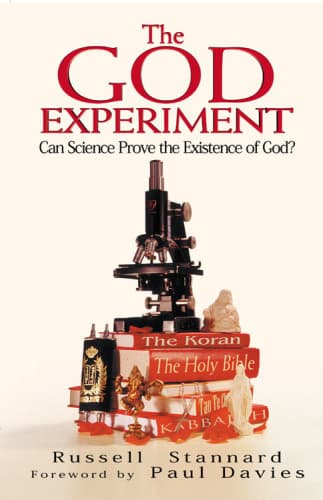
The God Experiment
تجربة الله
L'Expérience de Dieu
Editorial summary
This work presents a physicist's investigation into the relationship between modern scientific understanding and religious belief, specifically examining whether scientific methodology can meaningfully address questions about God's existence and nature. Stannard, drawing on his dual expertise as a practicing physicist and lay theologian, argues that while science cannot definitively prove or disprove God's existence, certain scientific discoveries and methodologies provide compelling grounds for considering theistic explanations of reality.
The author structures his argument around what he terms "experimental theology," proposing that religious claims can be subjected to forms of empirical investigation analogous to scientific experiments. He examines phenomena such as the efficacy of prayer, religious experience, and the fine-tuning of physical constants, treating each as a potential "experiment" that might yield evidence relevant to the God hypothesis. Stannard contends that while these investigations do not produce the kind of repeatable, controlled results expected in physics laboratories, they nonetheless generate data worthy of serious intellectual consideration.
Central to Stannard's approach is his rejection of the conflict thesis that positions science and religion as inherently antagonistic. He critiques both scientific materialists who dismiss religious considerations as meaningless and religious fundamentalists who reject scientific findings that challenge literal interpretations of scripture. Instead, he advocates for a complementary relationship where scientific and theological insights mutually inform human understanding of reality. His analysis particularly engages with the anthropic principle and cosmological fine-tuning, suggesting these point toward purposive design while acknowledging alternative explanations.
The work contributes significantly to natural theology discourse by demonstrating how a practicing scientist can maintain intellectual integrity while exploring theological questions. Stannard's methodology combines empirical observation with philosophical reflection, offering a model for constructive dialogue between scientific and religious communities. His treatment of prayer studies and religious experience brings scientific scrutiny to traditionally faith-based claims while respecting their phenomenological significance.
The monograph's importance lies in its bridging function between academic disciplines often viewed as incompatible. By treating the God question as amenable to investigative approaches inspired by scientific method, Stannard opens new avenues for theological inquiry that neither compromise scientific rigor nor dismiss religious sensibility. His work challenges both atheistic scientists and anti-scientific believers to reconsider their positions, advocating for a more nuanced understanding of how empirical investigation might illuminate metaphysical questions.
Argument formulations engaged
Related works
Stannard, Russel (1999). The God Experiment. Hidden Spring.
@book{the-god-experiment-1999,
  author    = {Stannard, Russel},
  title     = {The God Experiment},
  year      = {1999},
  publisher = {Hidden Spring},
  url       = {https://god-database.com/en/works/the-god-experiment-1999}
}