
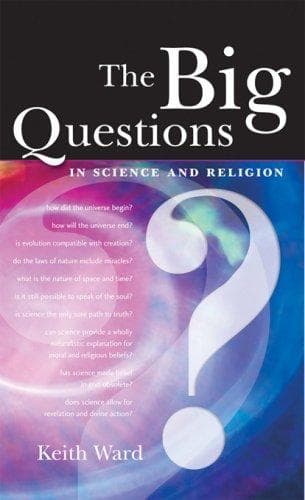
The Big Questions in Science and Religion
الأسئلة الكبيرة في العلم والدين
Les grandes questions en science et religion
Editorial summary
Keith Ward's monograph addresses twelve fundamental questions at the intersection of scientific inquiry and religious thought, offering a nuanced exploration of how these traditionally opposed domains might achieve productive dialogue. Ward challenges the prevailing narrative of inevitable conflict between science and religion, arguing instead for their potential complementarity in addressing ultimate questions about reality, consciousness, and human purpose.
The work systematically examines contentious issues including the origin of the universe, the nature of consciousness, evolutionary theory, and the possibility of miracles. Ward critiques both scientific materialism and religious fundamentalism, positioning himself against reductionist accounts that dismiss either scientific evidence or religious experience. His methodology combines philosophical analysis with scientific literacy, drawing on quantum physics, evolutionary biology, and neuroscience while engaging seriously with theological traditions.
Ward argues that science, while extraordinarily successful in explaining physical processes, encounters explanatory limits when addressing questions of ultimate meaning, moral value, and conscious experience. He contends that religious frameworks, properly understood, need not contradict scientific findings but can provide complementary perspectives on these boundary questions. Against militant atheists like Richard Dawkins and Daniel Dennett, Ward maintains that their dismissal of religious thought often rests on philosophical assumptions rather than scientific necessity.
The author develops a critical realist position that acknowledges both the reality of the physical world studied by science and the validity of religious experience. He argues that consciousness poses particular challenges to purely materialist accounts, suggesting that theistic frameworks might better accommodate the irreducible nature of subjective experience. Ward also addresses the fine-tuning of cosmological constants, arguing that while not constituting proof of divine design, such observations remain consonant with theistic interpretation.
Throughout, Ward emphasizes intellectual humility, acknowledging the provisional nature of both scientific theories and theological doctrines. His approach seeks middle ground between naive compatibilism and irreconcilable conflict, proposing instead a model of critical engagement where science and religion mutually inform and constrain each other. The work's significance lies in its sophisticated treatment of perennial questions, offering resources for those seeking to navigate between scientific naturalism and traditional theism. Ward's contribution challenges simplistic narratives on both sides of the science-religion divide, advocating for a more nuanced understanding of how these domains relate to questions about ultimate reality, human nature, and cosmic purpose.
Argument formulations engaged
Related works
Ward, Keith (2008). The Big Questions in Science and Religion. Templeton Foundation Press.
@book{the-big-questions-in-science-and-religio,
  author    = {Ward, Keith},
  title     = {The Big Questions in Science and Religion},
  year      = {2008},
  publisher = {Templeton Foundation Press},
  url       = {https://god-database.com/en/works/the-big-questions-in-science-and-religion-2008}
}