
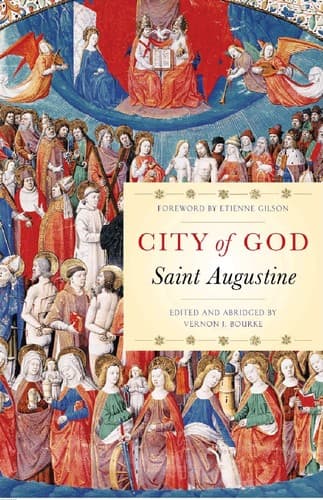
The City of God
مدينة الله
La Cité de Dieu
Editorial summary
Augustine of Hippo's monumental work "The City of God" stands as one of the most influential Christian philosophical texts in Western thought, offering a comprehensive defense of Christianity against pagan criticism while articulating a sophisticated theology of history. Written in response to the sack of Rome in 410, the work addresses pagan accusations that Christianity weakened the empire, but transcends this immediate context to present a sweeping vision of divine providence and human destiny.
The text divides human existence into two cities: the earthly city (civitas terrena) founded on self-love and pride, and the city of God (civitas Dei) built on love of God and humility. Augustine argues that these two cities, though intermingled in temporal history, possess fundamentally different orientations and ultimate destinies. The earthly city seeks temporal power and glory, while the city of God pursues eternal beatitude. This dualistic framework provides Augustine with a hermeneutical key for interpreting both scripture and secular history.
Methodologically, Augustine combines philosophical argumentation with biblical exegesis and historical analysis. He systematically refutes pagan theology, demonstrating the logical inconsistencies in polytheistic worship and the moral failures of Roman gods. Drawing extensively on Platonic philosophy while transforming it through Christian revelation, he argues that true happiness and justice cannot be achieved through human effort alone but require divine grace. His critique extends beyond religious matters to encompass political philosophy, arguing that earthly kingdoms without justice are merely "great robberies."
The work's contribution to natural theology proves particularly significant. Augustine advances arguments for God's existence based on the order and beauty of creation, the human soul's restless desire for transcendence, and the universal human quest for happiness that finds fulfillment only in God. He develops a sophisticated account of divine providence that reconciles God's sovereignty with human free will, addressing the problem of evil through his doctrine of the privation of good.
Augustine's synthesis profoundly shaped medieval theology and continues to influence contemporary discussions about church-state relations, political theology, and the philosophy of history. His vision of history as linear rather than cyclical, progressing toward a divine telos, fundamentally transformed Western consciousness and remains central to debates about secularization, political authority, and the relationship between religious and temporal power.
Argument formulations engaged
Related works
Hippo, Augustine of (426). The City of God.
@book{the-city-of-god-426,
  author    = {Hippo, Augustine of},
  title     = {The City of God},
  year      = {426},
  url       = {https://god-database.com/en/works/the-city-of-god-426}
}