
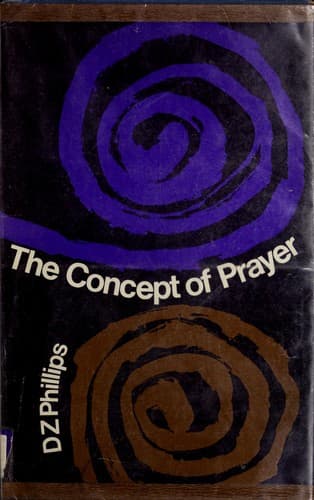
The Concept of Prayer
مفهوم الصلاة
Le Concept de la prière
Editorial summary
This monograph examines the philosophical complexities surrounding petitionary prayer, particularly the coherence of asking God to intervene in worldly affairs. Phillips challenges both traditional religious understandings and secular philosophical critiques by arguing that most discussions of prayer rest on fundamental conceptual confusions about what prayer actually means within religious life.
The work directly confronts the standard philosophical problem: if God is omniscient and benevolent, petitionary prayer appears either redundant (God already knows what we need) or presumptuous (attempting to change God's perfect will). Phillips rejects this entire framework, arguing that it misconceives prayer by treating it as a causal mechanism for securing desired outcomes. Instead, he proposes understanding prayer through Wittgensteinian language-game analysis, examining how religious believers actually use prayer within their forms of life.
Phillips argues against both crude interventionist theology and reductionist accounts that dismiss prayer as mere self-deception or psychological comfort. He particularly criticizes philosophers who analyze prayer from an external standpoint without attending to its internal grammar within religious practice. The monograph demonstrates that genuine religious prayer involves submission to God's will rather than attempts to bend that will to human desires. When believers pray for outcomes, Phillips suggests they are not attempting magical causation but rather expressing their deepest concerns while simultaneously accepting that these concerns must be subordinated to divine purposes.
The work's most significant contribution lies in its methodological approach. Phillips employs ordinary language philosophy to show that many apparent contradictions in prayer dissolve when we examine actual religious usage rather than imposing external philosophical frameworks. He argues that understanding prayer requires grasping the distinctive logic of religious discourse, where concepts like "answer to prayer" function differently than in ordinary causal explanations.
This monograph proved influential in philosophy of religion by shifting debate away from abstract metaphysical questions about divine action toward careful analysis of religious language and practice. Phillips demonstrates that prayer's meaning emerges from its role in shaping believers' attitudes and commitments rather than from any supposed causal efficacy. His work remains important for showing how philosophical analysis of religious concepts requires attention to their lived context rather than treating them as isolated metaphysical propositions. The text established Phillips as a leading voice in applying Wittgensteinian methods to religious phenomena.
Argument formulations engaged
Related works
Phillips, Dewi Zephaniah (1965). The Concept of Prayer. Routledge & Kegan Paul.
@book{the-concept-of-prayer-1965,
  author    = {Phillips, Dewi Zephaniah},
  title     = {The Concept of Prayer},
  year      = {1965},
  publisher = {Routledge & Kegan Paul},
  url       = {https://god-database.com/en/works/the-concept-of-prayer-1965}
}