
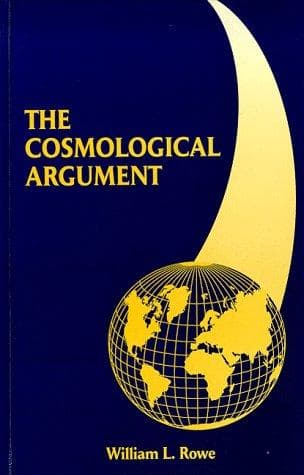
The Cosmological Argument
البرهان الكوني
L'Argument cosmologique
Editorial summary
This monograph provides a comprehensive philosophical analysis of the cosmological argument for God's existence, examining both historical formulations and contemporary debates. Rowe structures his investigation around two main versions: the argument from contingency, associated with Leibniz, and the argument from the impossibility of an infinite regress of causes, linked to Aquinas and Islamic philosophy.
The work begins by clarifying the cosmological argument's basic structure, which moves from observed features of the universe to the existence of a necessary being identified with God. Rowe distinguishes this approach from both ontological arguments, which proceed from concepts alone, and teleological arguments, which focus on design. He emphasizes that cosmological arguments depend on empirical premises about the world's existence or contingent nature.
Central to Rowe's analysis is his treatment of the Principle of Sufficient Reason, which underlies the Leibnizian version. He examines various formulations of this principle, from strong versions claiming every fact has an explanation to weaker versions applying only to contingent beings. The monograph carefully evaluates objections to this principle, including Humean skepticism about necessary existence and the possibility of brute facts. Rowe argues that while the Principle of Sufficient Reason has intuitive appeal, it faces significant philosophical challenges that undermine its use as a premise.
Regarding the Thomistic version, Rowe analyzes arguments against infinite causal regresses. He distinguishes between temporal and hierarchical series of causes, noting that Aquinas primarily concerned himself with the latter. The work examines whether an infinite regress is genuinely impossible or merely counterintuitive, considering mathematical analogies and metaphysical principles.
The monograph's distinctive contribution lies in its balanced critical assessment. While acknowledging the cosmological argument's historical importance and logical sophistication, Rowe identifies fundamental weaknesses in both major versions. He demonstrates how each version relies on controversial metaphysical principles that skeptics can reasonably reject. The analysis reveals tensions between the argument's empirical starting point and its metaphysical conclusions about necessary existence.
Rowe's work establishes a framework for subsequent discussions by clarifying key concepts, distinguishing argument versions, and identifying crucial assumptions. His rigorous philosophical method combines historical scholarship with logical analysis, making the monograph valuable for understanding both classical formulations and contemporary debates about cosmological reasoning in natural theology.
Argument formulations engaged
Related works
Rowe, William (1975). The Cosmological Argument. Princeton University Press.
@book{the-cosmological-argument-1975,
  author    = {Rowe, William},
  title     = {The Cosmological Argument},
  year      = {1975},
  publisher = {Princeton University Press},
  url       = {https://god-database.com/en/works/the-cosmological-argument-1975}
}