
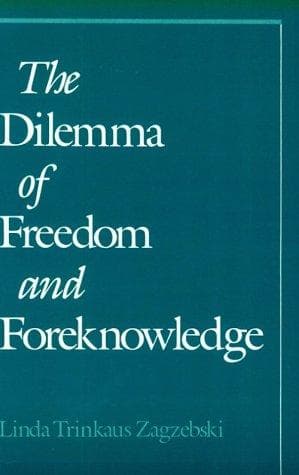
The Dilemma of Freedom and Foreknowledge
معضلة الحرية والعلم المسبق
Le Dilemme de la liberté et de la prescience
Editorial summary
This monograph presents a comprehensive philosophical examination of the traditional problem of reconciling divine foreknowledge with human free will. Zagzebski systematically analyzes whether God's perfect knowledge of future events is compatible with genuine human freedom, a dilemma that has occupied theologians and philosophers since antiquity.
The work begins by carefully delineating the logical structure of the foreknowledge problem. Zagzebski demonstrates that if God possesses infallible knowledge of all future human actions, a prima facie incompatibility emerges with libertarian free will, which requires that agents possess genuine alternative possibilities. She examines the modal logic underlying this apparent contradiction, showing how divine foreknowledge seems to render future actions necessary rather than contingent.
Zagzebski evaluates multiple historical and contemporary solutions to this dilemma. She critically assesses the Boethian solution, which places God outside temporal succession, arguing that divine timelessness alone cannot resolve the modal difficulties. The Ockhamist approach, which distinguishes between hard and soft facts about the past, receives detailed scrutiny. Zagzebski identifies significant problems with attempts to classify God's past beliefs as soft facts subject to counterfactual dependence on future free actions.
The monograph gives particular attention to the Molinist solution involving middle knowledge, wherein God knows what free agents would do in any possible circumstance. While acknowledging its theological elegance, Zagzebski raises concerns about the metaphysical grounding of counterfactuals of creaturely freedom. She argues that middle knowledge faces insurmountable difficulties in explaining how such counterfactuals can be both contingent and knowable prior to creation.
A distinctive contribution emerges in Zagzebski's analysis of the relationship between the foreknowledge dilemma and arguments for theological incompatibilism regarding providence. She demonstrates that similar logical structures underlie both problems, suggesting that solutions to one may transfer to the other. The work concludes by exploring whether abandoning either divine foreknowledge or libertarian freedom might be philosophically preferable to maintaining their compatibility through problematic metaphysical commitments.
Through rigorous logical analysis and careful engagement with the philosophical tradition, Zagzebski's monograph advances understanding of fundamental tensions between classical theistic attributes and human agency. Her work illuminates why this problem remains philosophically intractable while clarifying the costs of various proposed solutions.
Argument formulations engaged
Related works
Zagzebski, Linda (1991). The Dilemma of Freedom and Foreknowledge.
@book{the-dilemma-of-freedom-and-foreknowledge,
  author    = {Zagzebski, Linda},
  title     = {The Dilemma of Freedom and Foreknowledge},
  year      = {1991},
  url       = {https://god-database.com/en/works/the-dilemma-of-freedom-and-foreknowledge-1991}
}