
The Divine Relativity: A Social Conception of God
النسبية الإلهية: تصور اجتماعي لله
La Relativité divine : Une conception sociale de Dieu
Editorial summary
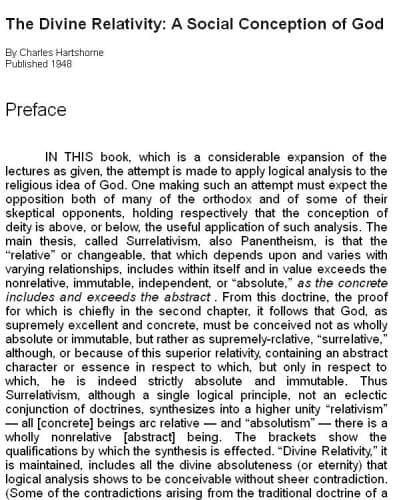
This monograph presents Hartshorne's systematic development of process theology, advancing a conception of God that radically departs from classical theism. The work argues that divine perfection must include relativity and temporal becoming, challenging traditional doctrines of divine immutability, impassibility, and timelessness. Hartshorne contends that a truly perfect being would be supremely related to all reality, experiencing and responding to creaturely experiences in each moment.
Central to Hartshorne's argument is his critique of what he terms "classical monopolar theism," which attributes only absolute, unchanging properties to God. He proposes instead a "dipolar" conception wherein God possesses both absolute and relative aspects. The absolute pole encompasses God's existence, ethical character, and capacity for knowledge, while the relative pole involves God's concrete experiences and responses to temporal events. This framework allows Hartshorne to maintain divine perfection while affirming that God genuinely experiences joy and sorrow in response to creaturely experiences.
The work develops this position through rigorous philosophical analysis, drawing on modal logic and metaphysical argumentation. Hartshorne examines the coherence of various divine attributes, arguing that many traditional formulations involve logical contradictions. For instance, he contends that omniscience, properly understood, must include knowledge of temporal events as they occur, requiring divine temporality. Similarly, he argues that perfect love necessitates genuine responsiveness to the beloved, undermining classical doctrines of divine impassibility.
Hartshorne engages extensively with both historical and contemporary sources. He critiques Thomas Aquinas's synthesis of Aristotelian philosophy with Christian theology, arguing that it compromises the biblical conception of a responsive, caring God. The work also responds to modern philosophers like Kant and Bradley, defending the metaphysical possibility of divine knowledge against various skeptical challenges.
The monograph's influence extends across multiple disciplines. In philosophy of religion, it inaugurated sustained debate about divine temporality and passibility that continues today. In systematic theology, it provided resources for theologians seeking to reconcile divine perfection with genuine divine-world interaction. Hartshorne's social conception of God, wherein divine perfection consists in supreme relatedness rather than absolute independence, offers a distinctive solution to perennial tensions between philosophical and religious conceptions of divinity. The work remains essential reading for understanding twentieth-century developments in philosophical theology and the emergence of process thought as a major theological movement.
Argument formulations engaged
Related works
Hartshorne, Charles (1948). The Divine Relativity: A Social Conception of God. Yale University Press.
@book{the-divine-relativity-a-social-conceptio,
  author    = {Hartshorne, Charles},
  title     = {The Divine Relativity: A Social Conception of God},
  year      = {1948},
  publisher = {Yale University Press},
  url       = {https://god-database.com/en/works/the-divine-relativity-a-social-conception-of-god-1948}
}