
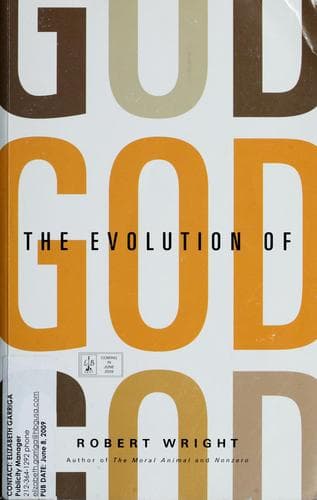
The Evolution of God
تطور الله
L'Évolution de Dieu
Editorial summary
Robert Wright's The Evolution of God presents an ambitious evolutionary account of how human conceptions of divinity have developed from prehistoric times to the present, arguing that this trajectory reveals a moral direction in history that may suggest something transcendent at work in the universe. Wright combines evolutionary psychology, game theory, and comparative religious history to trace how ideas about the divine have shifted from primitive animism through polytheism to the emergence of monotheism in Judaism, Christianity, and Islam.
Wright's central thesis challenges both traditional religious narratives and secular dismissals of religion. He argues that while supernatural beliefs themselves may be illusory, the historical pattern of religious evolution demonstrates an expanding moral imagination driven by non-zero-sum dynamics—situations where cooperation benefits all parties. As human societies have grown more interconnected through trade, technology, and cultural exchange, religious concepts have correspondingly evolved toward greater universalism and moral inclusivity. This process, Wright contends, is not random but follows a discernible direction toward expanded moral consideration and reduced tribalism.
The work engages critically with both New Atheist reductionism and conventional theological accounts. Against figures like Richard Dawkins and Daniel Dennett, Wright argues that religion's persistence and evolution cannot be explained merely as parasitic memes or cognitive errors. While accepting naturalistic explanations for religion's origins, he maintains that the trajectory of religious development points toward something meaningful about the structure of reality itself. Conversely, Wright challenges traditional believers by treating sacred texts as human documents that reflect the cultural contexts of their composition rather than timeless divine revelation.
Wright's methodology combines historical analysis with evolutionary and game-theoretic frameworks, examining how changing material conditions have shaped religious ideas. He traces how ancient Israel's conception of Yahweh evolved from a tribal warrior deity to a universal God, how early Christianity transformed from an apocalyptic Jewish sect to a universal religion, and how Islam emerged synthesizing elements from both traditions.
The work's significance lies in offering a middle path between religious and secular extremes, suggesting that the evolution of God concepts reflects an inherent moral directionality in the cosmos without requiring traditional supernatural beliefs. This position has influenced subsequent discussions about religion's role in human cooperation, moral progress, and the possibility of naturalistic spirituality.
Argument formulations engaged
Related works
Wright, Robert (2009). The Evolution of God. Little, Brown and Company.
@book{the-evolution-of-god-2009,
  author    = {Wright, Robert},
  title     = {The Evolution of God},
  year      = {2009},
  publisher = {Little, Brown and Company},
  url       = {https://god-database.com/en/works/the-evolution-of-god-2009}
}