
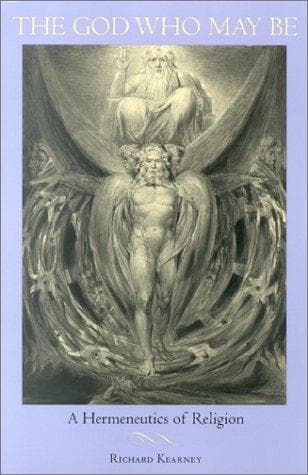
The God Who May Be: A Hermeneutics of Religion
الله الذي قد يكون: هرمنيوطيقا الدين
Le Dieu Qui Peut Être : Une Herméneutique de la Religion
Editorial summary
Richard Kearney's The God Who May Be: A Hermeneutics of Religion presents a radical reconceptualization of divinity through the lens of possibility rather than actuality. This work intervenes in contemporary philosophical theology by proposing an eschatological hermeneutics that understands God not as the omnipotent Being of classical metaphysics, but as the "God of the possible" who perpetually comes toward humanity from the future.
Kearney develops his thesis through a sustained engagement with continental philosophy, drawing particularly on phenomenology and deconstruction while maintaining critical distance from both traditions. He argues that traditional onto-theology, which conceives God as Supreme Being or pure actuality, has reached an impasse that contributes to both fundamentalist absolutism and nihilistic atheism. Against this binary, Kearney proposes understanding divine transcendence through the category of possibility—God as the "may-be" who empowers human ethical action without determining it.
The work proceeds through careful exegesis of biblical narratives, particularly the transfiguration and resurrection accounts, which Kearney reads as revealing God's kenotic self-emptying into possibility. He supplements this scriptural hermeneutics with analyses of literary texts from Joyce, Proust, and Woolf, demonstrating how poetic imagination can disclose dimensions of the sacred unavailable to conceptual theology. This methodological pluralism allows Kearney to navigate between Levinas's ethical transcendence and Derrida's deconstructive undecidability, while drawing on Ricoeur's hermeneutical philosophy.
Central to Kearney's argument is the notion of "ana-theism"—a return to God after the death of God that embraces both faith and doubt. This position challenges new atheists who dismiss religious possibility altogether, as well as fundamentalists who claim certain possession of divine truth. By reconceiving God as possibility rather than power, Kearney argues for a post-metaphysical theology that preserves divine transcendence while affirming human responsibility.
The work's significance lies in its attempt to articulate a "third way" beyond both dogmatic theism and reductive atheism. Kearney's eschatological hermeneutics offers resources for conceiving religious faith after the critique of ontotheology, making space for a God who is neither the omnipotent sovereign of classical theism nor merely a human projection. This contribution resonates with broader postmodern attempts to think transcendence without metaphysical foundations, while maintaining the ethical import of religious traditions.
Argument formulations engaged
Related works
Kearney, Richard (2001). The God Who May Be: A Hermeneutics of Religion. Indiana University Press.
@book{the-god-who-may-be-a-hermeneutics-of-rel,
  author    = {Kearney, Richard},
  title     = {The God Who May Be: A Hermeneutics of Religion},
  year      = {2001},
  publisher = {Indiana University Press},
  url       = {https://god-database.com/en/works/the-god-who-may-be-a-hermeneutics-of-religion-2001}
}