
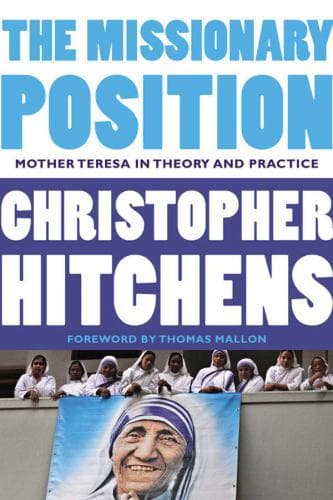
The Missionary Position: Mother Teresa in Theory and Practice
موقف التبشير: الأم تيريزا في النظرية والممارسة
La Position Missionnaire : Mère Teresa en Théorie et en Pratique
Editorial summary
This polemical work presents a sustained critique of Mother Teresa of Calcutta, challenging her public image as a humanitarian saint and examining the religious ideology underlying her charitable work. Hitchens constructs his argument through investigative journalism and ideological analysis, drawing on firsthand accounts, financial records, and interviews with former volunteers to present Mother Teresa as a fundamentalist whose primary concern was promoting Catholic doctrine rather than alleviating suffering.
The monograph's central thesis positions Mother Teresa's work as actively harmful to the poor, arguing that her Missionaries of Charity provided substandard medical care while accumulating substantial wealth. Hitchens documents instances where treatable patients were denied proper medication or surgery, with suffering valorized as spiritually beneficial. He contends that her facilities functioned more as "Houses of the Dying" where conversion attempts took precedence over medical intervention. The work examines her relationships with dictators and fraudulent financiers, suggesting these associations reveal priorities inconsistent with humanitarian ethics.
Hitchens employs his characteristic antitheistic framework to analyze how religious ideology shapes charitable practice. He argues that Mother Teresa's theology of suffering - viewing poverty and pain as gifts from God that bring one closer to Christ - led to policies that perpetuated rather than alleviated misery. The work critiques her opposition to contraception and abortion even in cases of rape or extreme poverty, presenting these positions as doctrine triumphing over compassion.
The monograph contributes to broader debates about religion's social role by examining how theological commitments can corrupt humanitarian efforts. Hitchens challenges the assumption that religious charity is inherently benevolent, using Mother Teresa as a case study in how dogma can transform care for the vulnerable into ideological exploitation. His analysis extends beyond individual criticism to indict the media and Western donors who uncritically promoted her image without investigating her actual practices.
While primarily a work of journalism, the text advances philosophical arguments about the relationship between religious faith and moral action. Hitchens suggests that supernatural beliefs necessarily distort ethical priorities, leading believers to value doctrinal purity over human welfare. This case study thus serves his larger antitheistic project of demonstrating religion's harmful effects on society, contributing empirical ammunition to theoretical critiques of religious morality.
Argument formulations engaged
Related works
Hitchens, Christopher (1995). The Missionary Position: Mother Teresa in Theory and Practice. Verso.
@book{the-missionary-position-mother-teresa-in,
  author    = {Hitchens, Christopher},
  title     = {The Missionary Position: Mother Teresa in Theory and Practice},
  year      = {1995},
  publisher = {Verso},
  url       = {https://god-database.com/en/works/the-missionary-position-mother-teresa-in-theory-and-practice-1995}
}