
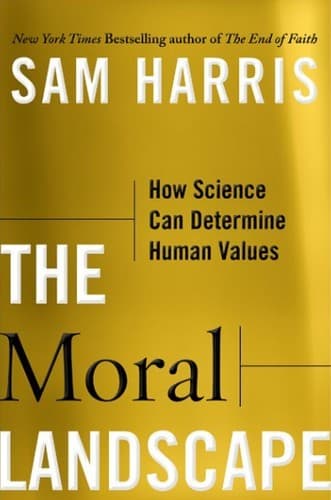
The Moral Landscape: How Science Can Determine Human Values
المشهد الأخلاقي: كيف يمكن للعلم أن يحدد القيم الإنسانية
Le Paysage Moral : Comment la Science Peut Déterminer les Valeurs Humaines
Editorial summary
Sam Harris's "The Moral Landscape" presents a provocative argument that science can and should determine human values, directly challenging the traditional separation between empirical facts and moral judgments. Harris, a neuroscientist and prominent New Atheist, contends that questions about human wellbeing possess objectively correct answers that neuroscience and related fields can discover. This thesis positions itself against both religious claims to moral authority and secular moral relativism, arguing instead for a scientific foundation for ethics.
The work's central metaphor depicts human wellbeing as a landscape with peaks representing states of maximum flourishing and valleys representing depths of suffering. Harris argues that science can map this terrain and guide humanity toward the peaks. He grounds this claim in a utilitarian framework where conscious creatures' experiences of suffering and flourishing constitute the only meaningful basis for moral values. Since consciousness emerges from brain states that science can study, Harris maintains that neuroscience can identify which actions and social arrangements promote wellbeing.
Harris directly confronts religious morality, particularly criticizing faith-based ethical systems that privilege divine commands over empirical consequences for human welfare. He argues that religious moral codes often perpetuate unnecessary suffering and inhibit human flourishing based on supernatural claims lacking evidential support. The work extends the New Atheist critique beyond epistemology into ethics, suggesting that abandoning religious frameworks would improve moral reasoning and outcomes.
The philosophical implications prove significant for debates about God's existence and necessity. If science can determine moral truths, then divine command theory loses its claim as the sole objective foundation for ethics. Harris effectively argues that atheists need not embrace moral relativism, as critics often charge, but can instead ground objective morality in scientific facts about conscious experience. This move attempts to neutralize a common theistic argument that God's existence provides the only basis for objective moral values.
The work generated substantial controversy among both philosophers and scientists who questioned whether Harris successfully bridges the is-ought gap that David Hume identified. Critics argue that Harris smuggles normative assumptions into his seemingly descriptive framework, particularly his foundational premise that wellbeing matters morally. Nevertheless, "The Moral Landscape" represents an influential attempt to extend scientific naturalism into moral philosophy while maintaining moral realism, thereby challenging both religious ethics and postmodern relativism through an explicitly atheistic but morally objectivist framework.
Argument formulations engaged
Related works
Harris, Sam (2010). The Moral Landscape: How Science Can Determine Human Values. Free Press.
@book{the-moral-landscape-how-science-can-dete,
  author    = {Harris, Sam},
  title     = {The Moral Landscape: How Science Can Determine Human Values},
  year      = {2010},
  publisher = {Free Press},
  url       = {https://god-database.com/en/works/the-moral-landscape-how-science-can-determine-human-values-2010}
}