
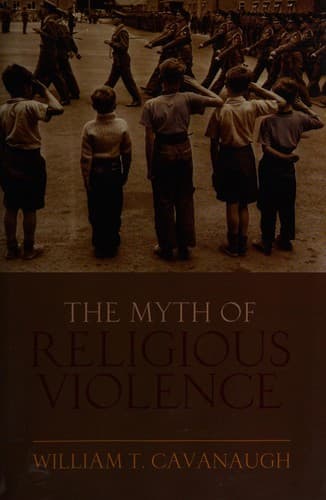
The Myth of Religious Violence
أسطورة العنف الديني
Le Mythe de la Violence religieuse
Editorial summary
Cavanaugh's monograph presents a systematic critique of the widespread assumption that religion possesses an inherent propensity toward violence. The work challenges the conventional narrative that portrays religion as a uniquely dangerous force requiring secular restraint, arguing instead that this narrative serves specific political functions in legitimating the modern nation-state and its monopoly on legitimate violence.
The author employs historical genealogy and conceptual analysis to demonstrate that the category of "religion" as a transhistorical and transcultural phenomenon distinct from "secular" politics represents a modern Western construction. Cavanaugh traces how this distinction emerged during the early modern period, particularly in the context of the so-called Wars of Religion, which he argues were primarily conflicts over political sovereignty rather than theological disputes. Through detailed examination of historical evidence, he shows how these wars involved Catholics fighting Catholics and Protestants fighting Protestants as often as they involved interconfessional conflict, suggesting that political rather than religious motivations predominated.
Central to Cavanaugh's argument is the claim that the religion-secular distinction functions ideologically to marginalize certain forms of discourse and practice while privileging others. By defining religion as inherently prone to irrational violence, secular liberalism justifies its own forms of violence as rational and necessary. The author examines how this narrative operates in contemporary contexts, from Supreme Court decisions to foreign policy justifications, demonstrating how the myth of religious violence serves to legitimate state violence while obscuring its religious dimensions.
The work engages critically with prominent theorists including John Rawls, Richard Rorty, and Mark Juergensmeyer, challenging their assumptions about religion's essential characteristics. Cavanaugh argues that nationalism, capitalism, and other supposedly secular ideologies exhibit the same features typically attributed to religion, including absolutist claims, ritualistic practices, and willingness to kill and die for transcendent causes.
This monograph contributes significantly to debates about secularization, political theology, and the relationship between religion and violence. By exposing the constructed nature of the religion-secular divide, Cavanaugh opens space for reconsidering how societies understand and manage different forms of allegiance and authority. His work suggests that addressing violence requires examining all absolutist ideologies rather than scapegoating religion, while recognizing how the modern state itself functions through quasi-religious mechanisms of legitimation and devotion.
Argument formulations engaged
Related works
Cavanaugh, William (2009). The Myth of Religious Violence.
@book{the-myth-of-religious-violence-2009,
  author    = {Cavanaugh, William},
  title     = {The Myth of Religious Violence},
  year      = {2009},
  url       = {https://god-database.com/en/works/the-myth-of-religious-violence-2009}
}