
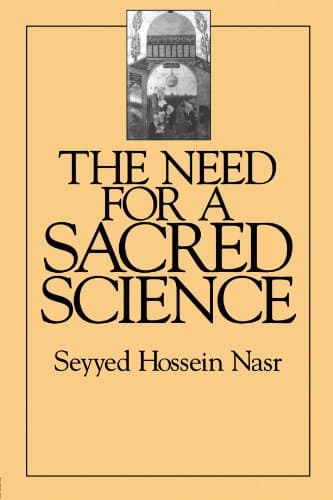
The Need for a Sacred Science
الحاجة إلى علم مقدس
Le Besoin d'une Science sacrée
Editorial summary
This collection presents Nasr's sustained argument for recovering sacred science as an essential corrective to the spiritual crisis of modernity. Writing from within the Traditionalist school associated with René Guénon and Frithjof Schuon, Nasr contends that modern secular science, despite its technical achievements, has severed humanity from divine reality by reducing nature to mere material mechanism. The essays collectively advocate for a science rooted in metaphysical principles that recognizes nature as theophany—a manifestation of divine presence and wisdom.
Nasr's methodology combines comparative religion, philosophy of science, and traditional metaphysics to critique the epistemological foundations of modern scientific materialism. He argues that pre-modern civilizations, whether Islamic, Christian, Hindu, or Buddhist, possessed sciences that integrated empirical observation with spiritual insight, viewing the natural world as a sacred text revealing divine truths. Modern science's rejection of formal and final causes, its quantitative reductionism, and its denial of vertical causality have, in Nasr's analysis, created an unprecedented alienation between humanity and both nature and God.
The work engages critically with defenders of scientific naturalism and secular humanism, arguing that their worldview inevitably leads to environmental destruction, psychological fragmentation, and spiritual nihilism. Nasr particularly challenges the assumption that scientific progress necessarily entails abandoning traditional metaphysics. Instead, he proposes that authentic science must acknowledge multiple levels of reality, from the material to the spiritual, and recognize that empirical methods alone cannot exhaust nature's intelligibility.
Central to Nasr's argument is the claim that recovering sacred science is not merely an intellectual exercise but a spiritual imperative for human survival. He contends that environmental crisis, technological dehumanization, and existential meaninglessness all stem from forgetting the sacred dimension of existence. The collection draws extensively from Islamic philosophy, particularly the illuminationist tradition, while engaging sympathetically with other religious traditions' approaches to nature.
The significance of this work lies in its comprehensive articulation of a traditionalist response to modernity's desacralization of nature and knowledge. Nasr offers not simply a critique but a constructive vision of how contemporary humanity might reintegrate scientific inquiry with spiritual wisdom. His position challenges both religious fundamentalists who reject science and scientific materialists who dismiss the sacred, proposing instead a synthesis grounded in perennial philosophy.
Argument formulations engaged
Nasr, Seyyed Hossein (1993). The Need for a Sacred Science. Taylor & Francis.
@book{the-need-for-a-sacred-science-1993,
  author    = {Nasr, Seyyed Hossein},
  title     = {The Need for a Sacred Science},
  year      = {1993},
  publisher = {Taylor & Francis},
  url       = {https://god-database.com/en/works/the-need-for-a-sacred-science-1993}
}