
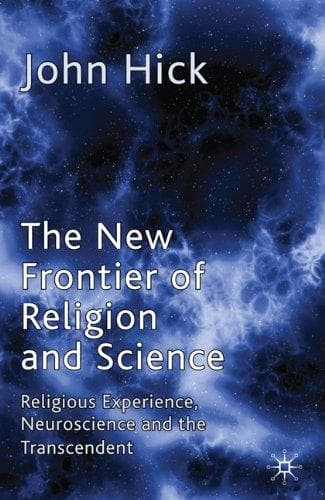
The New Frontier of Religion and Science
الحدود الجديدة للدين والعلم
La Nouvelle Frontière de la Religion et de la Science
Editorial summary
John Hick's The New Frontier of Religion and Science presents a comprehensive philosophical framework for reconceptualizing the relationship between religious faith and scientific inquiry in the 21st century. Writing as one of the foremost philosophers of religious pluralism, Hick argues that the traditional conflict model between religion and science rests on outdated epistemological assumptions that fail to recognize the complementary nature of these two domains of human understanding.
The work develops three central arguments. First, Hick contends that both religious experience and scientific observation constitute valid forms of empirical engagement with reality, though they operate at different levels of human consciousness. He draws on developments in cognitive science and neuroscience to suggest that religious experiences, while subjectively mediated, may represent genuine encounters with transcendent dimensions of reality that lie beyond the scope of scientific methodology. Second, he advances a critical realist position that acknowledges the interpretive element in both scientific theories and religious doctrines, arguing that both enterprises involve creative human responses to aspects of reality that exceed complete comprehension. Third, Hick proposes that the evolution of consciousness itself provides a bridge between scientific and religious worldviews, suggesting that the emergence of moral and spiritual awareness represents a natural development within the cosmic process described by science.
Methodologically, Hick employs comparative philosophy of religion alongside engagement with contemporary physics, evolutionary biology, and consciousness studies. He particularly challenges the reductionist materialism of figures like Richard Dawkins and Daniel Dennett, while also critiquing fundamentalist religious positions that reject scientific findings. His approach draws on process philosophy, particularly the work of Whitehead, to articulate a vision of reality as inherently creative and purposive without requiring supernatural intervention in natural processes.
The significance of Hick's contribution lies in his sophisticated attempt to move beyond both the warfare thesis and simplistic harmonization efforts. By grounding his analysis in epistemological pluralism rather than metaphysical dualism, he opens space for genuine dialogue between scientific and religious communities. His work particularly influences discussions about consciousness, ethics, and ultimate meaning, suggesting that a mature worldview requires both scientific understanding of natural processes and openness to transcendent dimensions of human experience. The monograph thus represents a major statement in the ongoing effort to develop intellectually credible forms of religious belief that fully embrace scientific knowledge while maintaining the irreducible significance of spiritual insight.
Argument formulations engaged
Related works
Hick, John (2006). The New Frontier of Religion and Science. Palgrave Macmillan.
@book{the-new-frontier-of-religion-and-science,
  author    = {Hick, John},
  title     = {The New Frontier of Religion and Science},
  year      = {2006},
  publisher = {Palgrave Macmillan},
  url       = {https://god-database.com/en/works/the-new-frontier-of-religion-and-science-2006}
}