
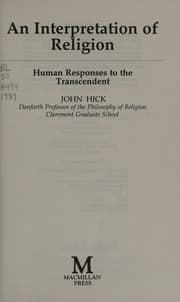
An Interpretation of Religion: Human Responses to the Transcendent
تفسير الدين: الاستجابات الإنسانية للمتعالي
Une interprétation de la religion : Réponses humaines au transcendant
Editorial summary
John Hick's An Interpretation of Religion represents a major contribution to religious pluralism and the philosophical understanding of religious diversity. The work develops a comprehensive theory that seeks to explain how the world's great religions can be understood as different human responses to the same ultimate transcendent reality, which Hick terms "the Real."
Central to Hick's argument is his distinction between the Real an sich (the Real in itself) and the Real as humanly experienced and conceptualized. Drawing on Kantian epistemology, he argues that the Real in itself is beyond all human categories and concepts, neither personal nor impersonal, neither one nor many. However, this ultimate reality is experienced through different cultural and religious lenses, resulting in the diverse forms of religious life found across human history. The personal deities of theistic traditions and the impersonal absolutes of non-theistic traditions represent equally valid human responses to the same transcendent reality.
Hick's methodology combines philosophical analysis with extensive engagement with the phenomenology of religion. He examines mystical experiences, religious practices, and theological concepts across traditions, arguing that beneath their surface differences lies a common soteriological structure. All major religions, he contends, involve a transformation from self-centeredness to Reality-centeredness, though they conceptualize this transformation in culturally specific ways.
The work directly challenges both religious exclusivism and secular naturalism. Against exclusivists who claim unique access to divine truth, Hick argues that no single tradition can claim superiority given the equal spiritual and moral fruits evident across religions. Against naturalistic reductionism, he maintains that religious experience points to a genuine transcendent dimension of reality, though one that cannot be captured by any particular religious conceptual scheme.
Hick's pluralistic hypothesis has profound implications for interfaith dialogue, religious epistemology, and the philosophy of religion. By arguing that conflicting truth claims among religions often involve different phenomenal manifestations of the same noumenal reality, he provides a framework for affirming religious diversity while maintaining the cognitive significance of religious belief. His work remains influential in discussions of religious diversity, though it faces criticism from both traditional believers who reject his relativizing of specific religious claims and from naturalists who question his realist assumptions about transcendent reality.
Argument formulations engaged
Related works
Hick, John (1989). An Interpretation of Religion: Human Responses to the Transcendent. Yale University Press.
@book{an-interpretation-of-religion-human-resp,
  author    = {Hick, John},
  title     = {An Interpretation of Religion: Human Responses to the Transcendent},
  year      = {1989},
  publisher = {Yale University Press},
  url       = {https://god-database.com/en/works/an-interpretation-of-religion-human-responses-to-the-transcendent-1989}
}