
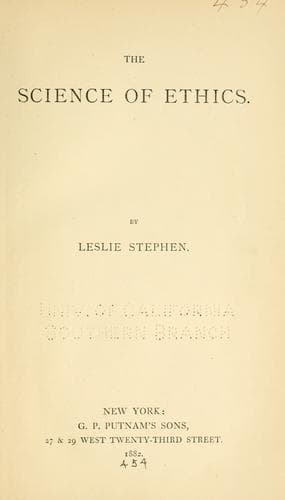
The Science of Ethics
علم الأخلاق
La Science de l'éthique
Editorial summary
This monograph represents a significant Victorian attempt to establish ethics on purely naturalistic foundations, explicitly rejecting theological justifications for moral principles. Stephen develops a comprehensive evolutionary account of morality, arguing that ethical systems emerge from biological and social necessities rather than divine commands or metaphysical truths. His project directly challenges contemporary religious apologetics that ground morality in God's will or nature, positioning itself as a scientific alternative to theological ethics.
Stephen's methodology combines Darwinian evolution with utilitarian philosophy, examining how moral sentiments develop through natural selection and social cooperation. He argues that altruistic behaviors evolve because they enhance group survival, not because they reflect divine moral law. This naturalistic framework extends to all aspects of ethics, from basic moral intuitions to complex social institutions. Stephen particularly emphasizes how religious morality itself represents an evolutionary adaptation rather than revealed truth, suggesting that theological ethics mistakes a natural phenomenon for a supernatural one.
The work engages critically with several intellectual traditions. Against natural theology, Stephen denies that moral order points to divine design, arguing instead that apparent moral purposiveness results from evolutionary processes. He challenges intuitionist philosophers who claim humans possess God-given moral faculties, proposing that conscience develops through social conditioning and inherited tendencies. His critique extends to Christian ethics specifically, analyzing how religious moral systems function sociologically while denying their claimed divine origins.
Stephen's contribution to the God debate lies in his systematic demonstration that morality requires no theological foundation. By providing detailed naturalistic explanations for phenomena traditionally attributed to divine influence, he undermines a major argument for God's existence and relevance. His analysis of how religious moral systems actually function socially, regardless of their truth claims, prefigures later sociological approaches to religion.
The monograph's significance extends beyond its immediate context. Stephen's evolutionary ethics influences subsequent naturalistic philosophy while his critique of theological morality remains relevant to contemporary debates about secular ethics. His work exemplifies the broader Victorian intellectual movement toward scientific materialism, showing how evolutionary theory could be applied beyond biology to challenge religious worldviews comprehensively. The text stands as an important document in the historical development of secular moral philosophy.
Argument formulations engaged
Stephen, Leslie (1882). The Science of Ethics. Smith, Elder & Co..
@book{the-science-of-ethics-1882,
  author    = {Stephen, Leslie},
  title     = {The Science of Ethics},
  year      = {1882},
  publisher = {Smith, Elder & Co.},
  url       = {https://god-database.com/en/works/the-science-of-ethics-1882}
}