
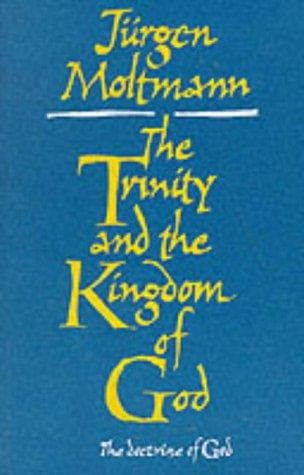
The Trinity and the Kingdom
الثالوث والملكوت
La Trinité et le Royaume
Editorial summary
Jürgen Moltmann's The Trinity and the Kingdom represents a significant contribution to twentieth-century trinitarian theology by proposing a social doctrine of the Trinity that directly challenges both Western theological tradition and modern political theology. Writing in the wake of Karl Barth's trinitarian revival yet departing significantly from Barthian methodology, Moltmann develops a systematic reconstruction of the doctrine of God that places divine relationality and suffering at its center.
The work advances three interconnected arguments. First, Moltmann critiques what he terms "Christian monotheism," particularly as developed in Western theology from Augustine through Aquinas to modern Protestant thought. He contends that emphasis on divine unity and sovereignty has produced a monarchical conception of God that legitimates earthly domination and hierarchical power structures. Second, he proposes instead a social Trinity of three distinct persons in perichoretic communion, drawing heavily on Eastern Orthodox theology, particularly the Cappadocian Fathers. This vision emphasizes the mutual indwelling and reciprocal relationships among Father, Son, and Spirit as constitutive of divine being itself. Third, Moltmann argues that this social Trinity provides the proper theological foundation for human community, offering a model of non-hierarchical, egalitarian relationships that challenges both political authoritarianism and religious patriarchalism.
Central to Moltmann's theological method is his concept of the "open Trinity." Against classical theism's emphasis on divine impassibility, he argues that God's trinitarian history includes genuine suffering through the cross and remains open to eschatological completion through creation's participation. This panentheistic framework, influenced by process thought yet grounded in biblical narrative, reconceives divine transcendence through radical immanence and vulnerability.
The work's significance extends beyond doctrinal theology to political and ecological thought. By linking trinitarian doctrine to liberation theology's concerns, Moltmann demonstrates how concepts of God directly shape social imagination and political practice. His critique of monotheistic sovereignty resonates with feminist theology's challenge to patriarchal God-language, while his emphasis on divine relationality anticipates later developments in relational ontology and ecological theology.
The Trinity and the Kingdom thus marks a pivotal moment in modern theology's engagement with the doctrine of God, moving beyond both traditional metaphysical speculation and Barthian revelational positivism toward a thoroughly relational, historically engaged, and politically conscious trinitarian theology that continues to influence contemporary theological discourse.
Argument formulations engaged
Related works
Moltmann, Jürgen (1981). The Trinity and the Kingdom.
@book{the-trinity-and-the-kingdom-1981,
  author    = {Moltmann, Jürgen},
  title     = {The Trinity and the Kingdom},
  year      = {1981},
  url       = {https://god-database.com/en/works/the-trinity-and-the-kingdom-1981}
}