
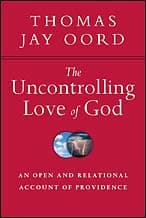
The Uncontrolling Love of God: An Open and Relational Account of Providence
محبة الله غير المسيطرة: تفسير منفتح وعلائقي للعناية الإلهية
L'Amour non contraignant de Dieu : Un récit ouvert et relationnel de la providence
Editorial summary
Thomas Jay Oord's The Uncontrolling Love of God presents a radical reconceptualization of divine providence that challenges both classical theism and contemporary theological alternatives. Writing within the open and relational theology movement, Oord develops what he terms "essential kenosis," a model that fundamentally reimagines God's relationship to creation and the problem of evil.
The work's central thesis contends that God's nature as uncontrolling love necessarily limits divine action in ways that traditional theology has been unwilling to acknowledge. Oord argues that God cannot unilaterally prevent genuine evil because divine love, by its very essence, must be persuasive rather than coercive. This position emerges from his engagement with process thought, particularly Alfred North Whitehead and Charles Hartshorne, while maintaining distinctions from classical process theology through his emphasis on divine love as God's essential attribute.
Oord structures his argument by first examining the inadequacies of existing theodicies, demonstrating how models of divine self-limitation fail to resolve the problem of gratuitous suffering. He critiques both Arminian free will defenses and Calvinist sovereignty doctrines as unable to explain why an omnipotent God permits horrendous evils. Against John Sanders and other open theists who maintain that God voluntarily self-limits, Oord contends that divine self-limitation must be involuntary, rooted in God's essential nature rather than divine choice.
The work's methodological approach combines philosophical theology with pastoral concern, drawing extensively from scientific discussions of emergence, complexity, and evolutionary biology. Oord argues that his model better accommodates contemporary scientific understanding while providing more satisfactory responses to existential questions of suffering. His engagement with neuroscience and quantum mechanics serves to illustrate how divine action might operate through persuasion at various levels of reality without violating natural regularities.
The book's significance lies in its bold attempt to preserve divine goodness by reconceiving divine power. By arguing that God necessarily cannot control creatures or circumstances, Oord offers a solution to the logical problem of evil that maintains God's perfect love while explaining the persistence of genuine evil. This position has provoked substantial debate within evangelical and process theology circles, challenging fundamental assumptions about divine attributes and the nature of providence. The work represents a pivotal contribution to contemporary discussions about divine action, theodicy, and the relationship between theology and science.
Argument formulations engaged
Related works
Oord, Thomas Jay (2015). The Uncontrolling Love of God: An Open and Relational Account of Providence. InterVarsity Press.
@book{the-uncontrolling-love-of-god-an-open-an,
  author    = {Oord, Thomas Jay},
  title     = {The Uncontrolling Love of God: An Open and Relational Account of Providence},
  year      = {2015},
  publisher = {InterVarsity Press},
  url       = {https://god-database.com/en/works/the-uncontrolling-love-of-god-an-open-and-relational-account-of-providence-2015}
}