
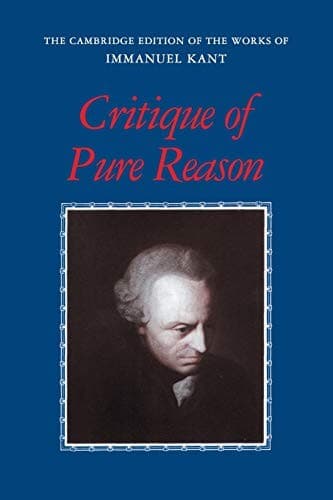
Critique of Pure Reason
نقد العقل المحض
Critique de la raison pure
Editorial summary
Kant's Critique of Pure Reason fundamentally transforms the philosophical discourse on God's existence by establishing the limits of human reason in metaphysical matters. The work systematically dismantles the traditional proofs for God's existence while simultaneously protecting religious belief from empirical refutation, creating a revolutionary framework that continues to shape theological and philosophical debates.
The text's most significant contribution to the God debate appears in the Transcendental Dialectic, where Kant examines three classical arguments for God's existence: the ontological, cosmological, and physico-theological proofs. He demonstrates that each proof commits fundamental errors by attempting to extend reason beyond possible experience. The ontological argument, associated with Anselm and refined by Descartes, fails because existence cannot be a predicate that adds to a concept. The cosmological argument, which reasons from contingent beings to a necessary being, illegitimately applies categories valid only within experience to transcendent reality. The physico-theological proof, arguing from design to designer, can at best establish an architect rather than an omnipotent creator.
Kant's critique operates through his distinction between phenomena and noumena, between things as they appear to us and things as they are in themselves. Since human knowledge requires both sensible intuition and conceptual understanding, and since God cannot be an object of sensible intuition, theoretical reason cannot demonstrate God's existence. This epistemological restriction challenges both rationalist metaphysics, particularly the Leibnizian-Wolffian school dominant in German philosophy, and empiricist skepticism derived from Hume.
However, Kant's position proves more nuanced than simple agnosticism. By limiting knowledge, he claims to make room for faith. While theoretical reason cannot prove God's existence, practical reason requires God as a postulate to ensure the possibility of the highest good, where virtue and happiness coincide. This move relocates the God question from metaphysics to ethics, establishing a moral rather than theoretical foundation for religious belief.
The work's enduring significance lies in its reconfiguration of the entire debate. Rather than arguing for or against God's existence, Kant questions the legitimacy of the question itself when posed in purely theoretical terms. This critical approach forces subsequent thinkers to address not merely whether God exists, but whether and how such a question can be meaningfully answered. Both religious and secular philosophers must now contend with Kant's demonstration that neither proof nor disproof of God's existence lies within the bounds of pure theoretical reason.
Argument formulations engaged
Related works
Kant, Immanuel (1781). Critique of Pure Reason.
@book{critique-of-pure-reason-1781,
  author    = {Kant, Immanuel},
  title     = {Critique of Pure Reason},
  year      = {1781},
  url       = {https://god-database.com/en/works/critique-of-pure-reason-1781}
}