
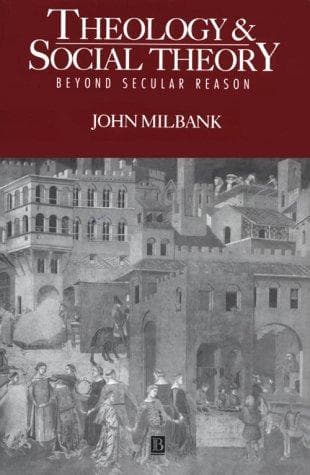
Theology and Social Theory
اللاهوت والنظرية الاجتماعية
Théologie et Théorie Sociale
Editorial summary
This groundbreaking work radically challenges the foundations of modern social theory by arguing that sociology and its allied disciplines rest upon an essentially heretical, secular theology. Milbank contends that from its inception, social theory has attempted to police and define the nature of religion, establishing itself as the master discourse that explains religious phenomena through supposedly neutral, scientific categories. This disciplinary imperialism, he argues, conceals its own theological commitments—specifically, a heterodox narrative that posits an original violence at the heart of human society.
The book's central thesis holds that secular social theory from Malebranche through Durkheim to Weber and beyond represents not the emergence of autonomous reason freed from theological prejudice, but rather a bastardized theology of its own. This "heretical discourse" assumes that conflict and power constitute the fundamental reality of human existence, thereby making peace merely a secondary modification of primordial antagonism. Against this narrative, Milbank proposes that Christian theology, properly understood, offers a counter-ontology of peace that exposes the mythological character of secular reason's claims to neutrality and scientific objectivity.
Milbank's method involves a genealogical excavation of social theory's hidden theological roots, demonstrating how supposedly secular thinkers like Hobbes, Rousseau, Kant, Hegel, Marx, Nietzsche, Heidegger, and Foucault all operate within implicitly theological frameworks that privilege violence over harmony. He argues that these frameworks emerged from voluntarist and nominalist corruptions of Christian orthodoxy, which severed the integral connection between reason and divine participation. The work culminates in proposing that Augustine's City of God provides the only genuine social theory—one that understands human community as grounded in the peaceful Trinity rather than in conflictual origins.
The significance of this intervention extends beyond academic theology into fundamental questions about the relationship between religious and secular knowledge. By exposing social theory's crypto-theological assumptions, Milbank opens space for theology to reclaim its voice in public discourse without accepting the subordinate position assigned to it by Enlightenment epistemology. His argument implies that attempts to understand society, politics, or ethics apart from theological categories inevitably smuggle in rival theological commitments. This bold thesis initiated the Radical Orthodoxy movement and continues to provoke vigorous debate about whether secular reason represents intellectual progress or a kind of Christian heresy.
Argument formulations engaged
Related works
Milbank, John (1990). Theology and Social Theory. Wiley-Blackwell.
@book{theology-and-social-theory-1990,
  author    = {Milbank, John},
  title     = {Theology and Social Theory},
  year      = {1990},
  publisher = {Wiley-Blackwell},
  url       = {https://god-database.com/en/works/theology-and-social-theory-1990}
}