
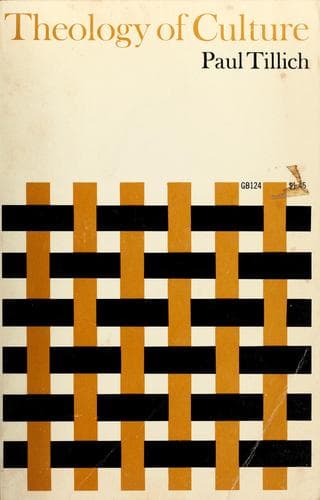
Theology of Culture
لاهوت الثقافة
Théologie de la Culture
Editorial summary
Paul Tillich's Theology of Culture represents a systematic attempt to bridge the perceived gulf between religious faith and modern secular culture. Writing in the mid-twentieth century context of increasing secularization and cultural fragmentation, Tillich develops a theological framework that locates the divine not in a supernatural realm separate from human experience, but within the depths of cultural expression itself. His central thesis contends that religion constitutes the substance of culture, while culture provides the form through which religious meaning manifests.
The work articulates Tillich's influential concept of God as "ultimate concern" - not a being among beings, but the ground of being itself. This formulation deliberately moves beyond traditional theistic categories that posit God as a supreme entity existing alongside the world. Instead, Tillich argues that authentic encounters with the divine occur through engagement with those dimensions of human experience that point toward ultimate meaning and value. Art, philosophy, politics, and even technology become potential mediators of religious depth when they express humanity's quest for the unconditional.
Tillich's method combines existentialist philosophy with Protestant theology, drawing particularly on German idealism and the phenomenology of religion. His correlation method seeks to demonstrate how cultural questions and theological answers mutually illuminate each other. Against both religious fundamentalism and secular reductionism, he maintains that neither pure faith nor pure reason alone can adequately address the human condition. His analysis directly challenges Karl Barth's neo-orthodox separation of revelation from culture, while also rejecting liberal theology's tendency to reduce religion to ethics or feeling.
The significance of this work lies in its sophisticated reformulation of how God-language functions in modernity. By locating the sacred within rather than against culture, Tillich provides resources for understanding religious experience without requiring literal belief in supernatural intervention. His influence extends across theology, religious studies, and philosophy of culture, offering a model for interpreting secular phenomena as potentially bearing religious significance. The work particularly matters for contemporary debates about post-secular society, suggesting ways that theological categories might remain meaningful even within predominantly secular cultural contexts. Tillich's approach continues to inform discussions about symbol, myth, and the nature of religious language in academic theology.
Argument formulations engaged
Related works
Tillich, Paul (1959). Theology of Culture. Oxford University Press.
@book{theology-of-culture-1959,
  author    = {Tillich, Paul},
  title     = {Theology of Culture},
  year      = {1959},
  publisher = {Oxford University Press},
  url       = {https://god-database.com/en/works/theology-of-culture-1959}
}