
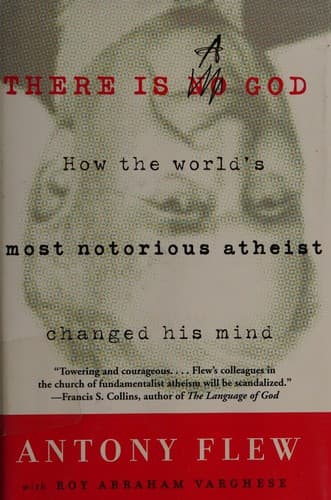
There Is a God: How the World's Most Notorious Atheist Changed His Mind
يوجد إله: كيف غيَّر أشهر ملحد في العالم رأيه
Il y a un Dieu : Comment l'Athée le plus Notoire du Monde a Changé d'Avis
Editorial summary
This monograph presents Antony Flew's intellectual journey from atheism to theism, co-authored with Roy Abraham Varghese. The work traces how one of the twentieth century's most prominent atheist philosophers came to accept the existence of God, offering both autobiographical narrative and philosophical argumentation for this dramatic reversal.
The book divides into two main sections. The first part recounts Flew's philosophical development, from his early commitment to atheism through his decades-long career defending naturalistic explanations against theistic arguments. Flew details his participation in major debates, his formulation of the presumption of atheism principle, and his influential critiques of religious belief. The second section examines the evidence and arguments that eventually persuaded him to abandon atheism. Central to his conversion is the argument from design, particularly as manifested in the fine-tuning of physical constants and the complexity of biological systems.
Flew emphasizes that his change of position results purely from following the evidence where it leads, maintaining his commitment to Socratic principles of rational inquiry. He argues that recent scientific discoveries, especially in cosmology and biology, point toward intelligent design. The emergence of life from non-life, the coded information in DNA, and the anthropic principle collectively suggest to Flew that naturalistic explanations prove inadequate. He concludes that only a divine intelligence can account for these phenomena.
The work engages critically with contemporary atheist thinkers, including Richard Dawkins and Daniel Dennett, while drawing support from scientists and philosophers who defend design arguments. Flew clarifies that his theism remains minimal - he accepts an Aristotelian conception of God as first cause and designer but does not embrace Christian doctrine or personal revelation. This distinction proves crucial, as Flew maintains his rejection of special revelation while accepting natural theology.
The monograph's significance lies not merely in documenting a famous conversion but in demonstrating how philosophical arguments about God remain responsive to empirical evidence. Flew's shift challenges the perception that commitment to scientific reasoning necessarily leads to atheism. His willingness to revise fundamental beliefs based on new evidence exemplifies intellectual honesty, though critics question whether age and outside influence affected his judgment. The work thus contributes both a personal testimony and a philosophical case for how scientific discoveries might support rather than undermine belief in God.
Argument formulations engaged
Related works
Varghese, Roy Abraham (2007). There Is a God: How the World's Most Notorious Atheist Changed His Mind. HarperOne.
@book{there-is-a-god-how-the-worlds-most-notor,
  author    = {Varghese, Roy Abraham},
  title     = {There Is a God: How the World's Most Notorious Atheist Changed His Mind},
  year      = {2007},
  publisher = {HarperOne},
  url       = {https://god-database.com/en/works/there-is-a-god-how-the-worlds-most-notorious-atheist-changed-his-mind-2007}
}