
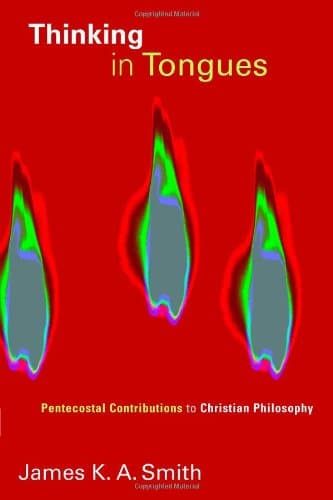
Thinking in Tongues
التفكير بالألسنة
Penser en Langues
Editorial summary
This monograph presents a philosophical defense of Pentecostal spirituality, arguing that Pentecostalism offers distinctive contributions to Christian philosophy and theology. Smith challenges prevailing academic dismissals of Pentecostal thought as anti-intellectual or philosophically naive, proposing instead that Pentecostal experience generates unique epistemological insights relevant to broader theological discourse.
The work develops a phenomenology of Pentecostal spirituality, examining how embodied practices such as speaking in tongues, divine healing, and prophetic utterance constitute forms of knowledge irreducible to propositional content. Smith draws extensively on continental philosophy, particularly the work of Maurice Merleau-Ponty and Pierre Bourdieu, to articulate how Pentecostal practices embody a tacit knowledge that precedes and exceeds conceptual articulation. This approach positions Pentecostalism as offering a critique of modern rationalism's privileging of disembodied reason.
Central to Smith's argument is the claim that Pentecostal spirituality instantiates an "affective epistemology" that recognizes the role of desire, emotion, and embodiment in human knowing. He contends that Pentecostalism's emphasis on immediate divine encounter challenges both cessationist theologies that limit God's contemporary action and philosophical frameworks that exclude supernatural agency from rational consideration. The work thus addresses debates about divine action, religious experience, and the relationship between faith and reason.
Smith engages critically with both sympathetic and hostile assessments of Pentecostalism. Against sociological reductions that explain Pentecostal growth through deprivation theories, he argues for taking Pentecostal truth claims seriously as philosophical propositions. Conversely, he challenges Pentecostals to develop more robust theological reflection on their experiential practices. The work particularly critiques Reformed epistemology's emphasis on belief over practice, suggesting that Pentecostalism offers resources for a more holistic account of religious knowledge.
The monograph's significance lies in its attempt to bridge experiential spirituality and academic philosophy, proposing that marginal religious traditions can contribute to mainstream philosophical discourse. By articulating a Pentecostal philosophy, Smith opens dialogue between charismatic Christianity and contemporary philosophy of religion, challenging both domains to reconsider their assumptions about knowledge, experience, and divine action. The work represents an important intervention in discussions about religious epistemology and the intellectual legitimacy of experiential faith traditions.
Argument formulations engaged
Related works
Smith, James K. A. (2010). Thinking in Tongues.
@book{thinking-in-tongues-2010,
  author    = {Smith, James K. A.},
  title     = {Thinking in Tongues},
  year      = {2010},
  url       = {https://god-database.com/en/works/thinking-in-tongues-2010}
}