
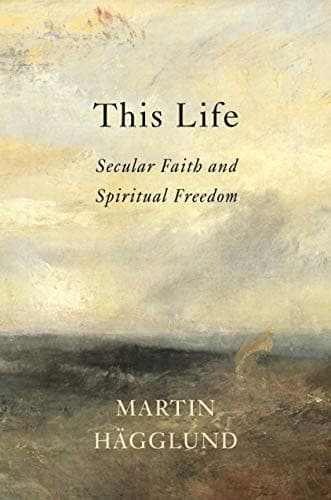
This Life: Secular Faith and Spiritual Freedom
هذه الحياة: الإيمان العلماني والحرية الروحية
Cette Vie : Foi Séculière et Liberté Spirituelle
Editorial summary
This monograph presents a sustained philosophical argument for secular faith as the foundation of meaningful human existence, challenging both religious and secular liberal conceptions of freedom, value, and social organization. Hägglund develops a systematic critique of religious faith through his concept of "secular faith," which he defines as commitment to finite life rather than eternal existence. The work engages extensively with major philosophical traditions, particularly German Idealism, existentialism, and Marxist thought, while offering critical readings of contemporary theologians and political theorists.
The central philosophical innovation lies in Hägglund's argument that mortality constitutes the necessary condition for anything to matter. He contends that religious faith, in seeking eternal life, fundamentally misunderstands the structure of care and commitment. Drawing on Heidegger's analysis of finitude while departing from his conclusions, Hägglund argues that only beings who can die can lead lives that matter. This temporal analysis extends beyond individual existence to encompass social and political institutions, which he examines through a reinterpretation of Marx's critique of capitalism.
The work's engagement with the God debate operates through immanent critique rather than external refutation. Hägglund analyzes religious thinkers including Augustine, Kierkegaard, C.S. Lewis, and Charles Taylor, demonstrating how their own accounts of faith implicitly depend on secular rather than religious values. He argues that what believers actually cherish in their religious commitments are finite relationships and temporal projects, not infinite existence. This method reveals internal contradictions within religious thought rather than simply opposing it from a naturalistic standpoint.
The political dimensions of Hägglund's argument culminate in his vision of "democratic socialism," which he presents as the institutional form adequate to secular faith. He connects his critique of religious eternity to a critique of capital's abstract value form, arguing that both represent alienations from finite life. The work thus bridges theoretical philosophy and political economy, offering a comprehensive secular worldview that addresses existential, ethical, and social questions typically associated with religious frameworks. Through close readings of literary works by Proust, Woolf, and Knausgård, Hägglund demonstrates how secular faith operates in concrete human experience, making his philosophical argument accessible while maintaining theoretical rigor throughout.
Argument formulations engaged
Hagglund, Martin (2019). This Life: Secular Faith and Spiritual Freedom.
@book{this-life-secular-faith-and-spiritual-fr,
  author    = {Hagglund, Martin},
  title     = {This Life: Secular Faith and Spiritual Freedom},
  year      = {2019},
  url       = {https://god-database.com/en/works/this-life-secular-faith-and-spiritual-freedom-2019}
}