
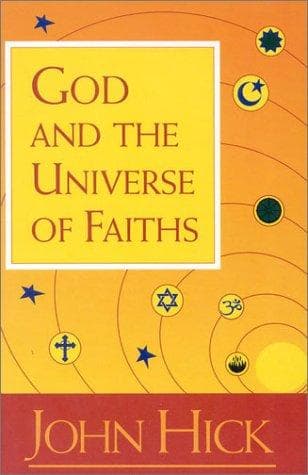
God and the Universe of Faiths
الله وعالم الأديان
Dieu et l'univers des fois
Editorial summary
This monograph represents a pivotal moment in twentieth-century philosophy of religion, introducing Hick's revolutionary thesis of religious pluralism. The work challenges traditional Christian exclusivism by proposing that all major world religions constitute equally valid paths to ultimate reality, which Hick terms "the Real." This thesis fundamentally reconfigures the relationship between Christianity and other faiths, moving from a model of superiority to one of parity.
Hick develops his argument through careful philosophical analysis combined with comparative religious studies. He examines the phenomenology of religious experience across traditions, finding striking similarities in mystical encounters, ethical teachings, and transformative outcomes. From these observations, he constructs a neo-Kantian framework distinguishing between the Real an sich (the divine reality as it exists in itself) and the Real as humanly experienced through various cultural-religious lenses. Different religions, he argues, represent diverse human responses to the same ultimate reality, shaped by distinct historical and cultural contexts.
The work directly confronts both Christian exclusivism and inclusivism. Against exclusivists who claim Christianity as the sole path to salvation, Hick argues that the moral and spiritual fruits evident in other traditions demonstrate their salvific efficacy. Against inclusivists who acknowledge truth in other religions while maintaining Christian superiority, he contends that no single tradition can claim privileged access to ultimate reality. His position draws on extensive engagement with Hindu, Buddhist, Islamic, and Jewish thought, demonstrating how each tradition's truth claims can be understood as culturally conditioned expressions of encounter with the Real.
Hick's methodology combines philosophical argumentation with empirical observation of religious phenomena. He employs epistemological analysis to show how religious beliefs are shaped by cultural contexts, while using moral criteria to evaluate religious traditions' practical outcomes. This approach reflects his broader philosophical commitment to critical realism and his theological journey from evangelical Christianity toward universalism.
The monograph's significance extends beyond academic theology into practical questions of interfaith dialogue and religious tolerance. By providing philosophical justification for religious pluralism, Hick's work has influenced liberal theological movements, interfaith initiatives, and debates about religious education in pluralistic societies. Critics from various traditions have challenged his thesis as reductionist, arguing it undermines distinctive truth claims and evacuates religions of their particular content. Nevertheless, the work remains foundational for contemporary discussions of religious diversity and the possibility of multiple authentic paths to the divine.
Argument formulations engaged
Related works
Hick, John (1973). God and the Universe of Faiths. Macmillan.
@book{god-and-the-universe-of-faiths-1973,
  author    = {Hick, John},
  title     = {God and the Universe of Faiths},
  year      = {1973},
  publisher = {Macmillan},
  url       = {https://god-database.com/en/works/god-and-the-universe-of-faiths-1973}
}