
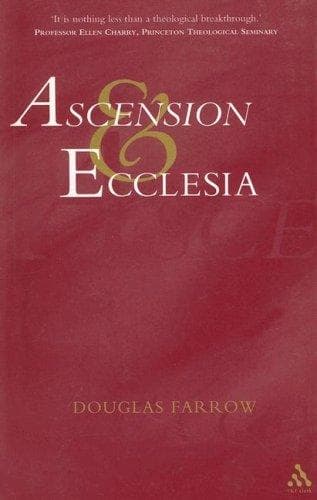
Ascension and Ecclesia
الصعود والكنيسة
Ascension et Ecclesia
Editorial summary
This monograph examines the theological significance of Christ's ascension for ecclesiology, arguing that the ascension constitutes the fundamental basis for understanding the church's nature, mission, and eschatological orientation. Farrow contends that modern theology has largely neglected the ascension, resulting in deficient ecclesiologies that fail to properly situate the church between Christ's departure and return.
The work develops its argument through careful engagement with patristic sources, particularly Irenaeus, while critically examining contemporary ecclesiological trends. Farrow demonstrates how the ascension creates a unique temporal and spatial tension for the church's existence, establishing it as a pilgrim community oriented toward the absent yet coming Lord. This ascension-shaped ecclesiology stands against both triumphalist conceptions that collapse eschatology into present institutional forms and spiritualizing tendencies that evacuate the church of its concrete, historical mission.
Central to Farrow's analysis is the Eucharist as the privileged locus where the ascension's ecclesiological implications become most apparent. He argues that eucharistic theology and practice must recover their properly eschatological dimension, understanding the sacrament not merely as Christ's presence but as the mode of his absence that anticipates his return. This eucharistic focus enables Farrow to address practical ecclesial matters while maintaining rigorous theological grounding.
The monograph engages critically with major twentieth-century theologians, including Barth, de Lubac, and Zizioulas, demonstrating how their ecclesiologies suffer from insufficient attention to the ascension. Farrow particularly challenges ecclesiologies that emphasize divine immanence at the expense of transcendence, arguing that the ascension preserves the proper creator-creature distinction while establishing genuine communion.
For the God debate, this work contributes a sophisticated theological argument about divine transcendence and presence. By focusing on the ascension, Farrow articulates how Christian theology maintains God's otherness while affirming real divine involvement in history. The ascension becomes the paradigm for understanding how God relates to creation without being absorbed into it. This approach offers resources for addressing modern tendencies toward both deism and pantheism, demonstrating how classical Christian theology navigates between divine absence and presence. The work's careful historical scholarship combined with constructive theological proposal provides a substantive contribution to understanding how the doctrine of God shapes ecclesial existence and practice.
Argument formulations engaged
Farrow, Douglas (2011). Ascension and Ecclesia. Bloomsbury T&T Clark.
@book{ascension-and-ecclesia-2011,
  author    = {Farrow, Douglas},
  title     = {Ascension and Ecclesia},
  year      = {2011},
  publisher = {Bloomsbury T&T Clark},
  url       = {https://god-database.com/en/works/ascension-and-ecclesia-2011}
}