
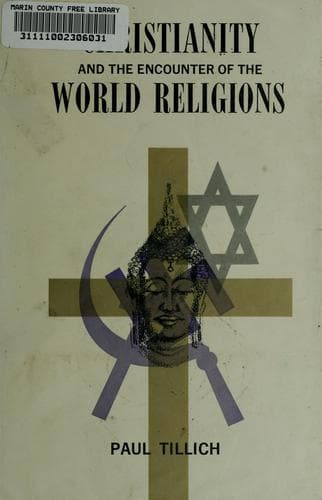
Christianity and the Encounter of the World Religions
المسيحية ولقاء أديان العالم
Le christianisme et la rencontre des religions mondiales
Editorial summary
This seminal work examines Christianity's relationship with other world religions through the lens of systematic theology and existential philosophy. Tillich develops a sophisticated framework for understanding religious pluralism that moves beyond both exclusivist claims and superficial syncretism. His central argument posits that Christianity must engage authentically with other religious traditions while maintaining its own theological integrity and universal aspirations.
The text introduces Tillich's concept of "dynamic typology," which categorizes religions based on their fundamental orientations toward the sacred. He distinguishes between religions emphasizing the sacramental presence of the divine in nature and history, those focused on mystical union, and prophetic traditions concerned with ethical transformation. Christianity, in his analysis, uniquely synthesizes these elements through its incarnational theology. This typological approach allows for genuine comparison without reducing religions to mere variations of a common essence.
Tillich's method combines phenomenological analysis with theological reflection, drawing on his earlier work on ultimate concern and the correlation between existential questions and religious answers. He argues that every religion contains both particular cultural expressions and universal dimensions that point toward ultimate reality. The encounter between religions occurs most profoundly at this level of ultimate concern, where different symbolic systems address shared human predicaments.
The work critically engages with both Christian triumphalism and secular relativism. Against exclusivists, Tillich maintains that revelation occurs outside Christianity, though he argues for the unique adequacy of Christian symbols in expressing the unity of the finite and infinite. Against relativists, he insists that religious truth claims matter and that criteria exist for evaluating religious adequacy, particularly the capacity to address existential estrangement without sacrificing either transcendence or immanence.
Tillich's contribution reshapes debates about religious pluralism by offering a third way between absolutism and relativism. His influence extends to subsequent discussions of interreligious dialogue, comparative theology, and the philosophy of religion. The work demonstrates how Christian theology can maintain its distinctive claims while acknowledging the spiritual depth of other traditions. His emphasis on the existential dimension of religious truth provides a framework for understanding how different religions can be both genuinely different and authentically revelatory, challenging simplistic approaches to religious diversity in an increasingly pluralistic world.
Argument formulations engaged
Related works
Tillich, Paul (1963). Christianity and the Encounter of the World Religions. Columbia University Press.
@book{christianity-and-the-encounter-of-the-wo,
  author    = {Tillich, Paul},
  title     = {Christianity and the Encounter of the World Religions},
  year      = {1963},
  publisher = {Columbia University Press},
  url       = {https://god-database.com/en/works/christianity-and-the-encounter-of-the-world-religions-1963}
}