
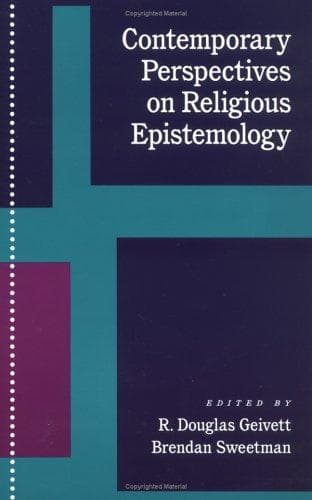
Contemporary Perspectives on Religious Epistemology
وجهات نظر معاصرة حول نظرية المعرفة الدينية
Perspectives contemporaines sur l'épistémologie religieuse
Editorial summary
This edited volume assembles significant contributions to the late twentieth-century debate over religious epistemology, examining the fundamental question of whether belief in God can be rationally justified. Geivett curates essays that represent the major positions emerging from the collapse of classical foundationalism and the subsequent reconfiguration of epistemological frameworks in philosophy of religion.
The collection engages directly with Alvin Plantinga's revolutionary claim that belief in God can be properly basic—that is, rationally held without inferential support from other beliefs. This Reformed epistemology challenges the evidentialist demand that theistic belief requires propositional evidence, arguing instead that such belief can arise from a properly functioning sensus divinitatis. Contributors examine whether this approach succeeds in establishing the rational permissibility of theistic belief while avoiding the charge of arbitrary fideism.
The volume presents competing perspectives on several crucial questions. First, it addresses whether religious experience can serve as evidence for God's existence, with some authors defending the evidential value of mystical or numinous experiences while others argue that such experiences remain epistemically ambiguous. Second, it examines the relationship between faith and reason, particularly whether religious commitment necessarily involves going beyond what evidence warrants. Third, contributors debate the implications of religious diversity for rational religious belief—if equally sincere and intelligent people reach contradictory religious conclusions, what follows for the rationality of any particular religious commitment?
Geivett's selection reflects the methodological pluralism characterizing contemporary religious epistemology. Some essays employ the tools of analytic epistemology, examining concepts like warrant, justification, and defeaters. Others draw on continental philosophy or theology to challenge the assumptions underlying standard epistemological approaches to religious belief. This diversity illuminates how the God question intersects with fundamental issues about the nature of knowledge, rationality, and human cognitive faculties.
The volume's significance lies in its comprehensive mapping of the post-foundationalist landscape in religious epistemology. By bringing together Reformed epistemologists, evidentialists, and their critics, Geivett provides readers with the conceptual resources to navigate contemporary debates about whether belief in God meets appropriate standards of rationality. The collection demonstrates that the question of God's existence cannot be separated from broader epistemological questions about how beliefs are justified, what counts as evidence, and whether there exist universal standards of rationality applicable to religious beliefs.
Argument formulations engaged
Related works
Geivett, R. Douglas (1992). Contemporary Perspectives on Religious Epistemology. Oxford University Press.
@book{contemporary-perspectives-on-religious-e,
  author    = {Geivett, R. Douglas},
  title     = {Contemporary Perspectives on Religious Epistemology},
  year      = {1992},
  publisher = {Oxford University Press},
  url       = {https://god-database.com/en/works/contemporary-perspectives-on-religious-epistemology-1992}
}