
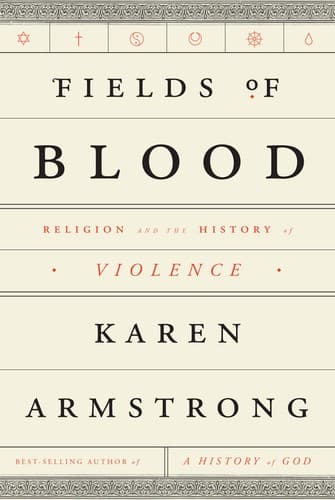
Fields of Blood: Religion and the History of Violence
ميادين الدم: الدين وتاريخ العنف
Champs de sang : La religion et l'histoire de la violence
Editorial summary
This sweeping historical analysis challenges the widespread assumption that religion constitutes the primary source of human violence. Armstrong examines conflicts from ancient Mesopotamia to contemporary terrorism, demonstrating that political, economic, and social factors typically drive warfare and brutality, with religious rhetoric serving as secondary justification rather than root cause.
The work directly confronts New Atheist arguments, particularly those advanced by Sam Harris, Christopher Hitchens, and Richard Dawkins, who attribute much historical bloodshed to religious belief. Armstrong argues these critics misunderstand both religion's historical role and the nature of pre-modern societies where religious and secular spheres remained undifferentiated. She traces how the modern Western concept of religion as a discrete, private belief system emerged only after the Peace of Westphalia in 1648, making anachronistic any application of this framework to earlier periods.
Armstrong's methodology combines comparative religion with political history, examining how agricultural surplus first enabled systematic warfare and how state formation required ideological justification that often employed religious language. She analyzes major traditions including Christianity, Islam, Judaism, Hinduism, Buddhism, and Confucianism, revealing how each has been co-opted for violent purposes while containing strong pacifist and compassionate elements. The Crusades, often cited as paradigmatic religious wars, emerge in her analysis as primarily territorial conflicts driven by economic pressures and political ambitions.
The book's significance for debates about God lies in its systematic decoupling of theistic belief from violent behavior. Armstrong demonstrates that secular ideologies proved equally capable of mass murder in the twentieth century, citing Stalin's purges and Mao's Cultural Revolution. She argues that violence stems from human nature and social structures rather than theological commitments, thereby undermining arguments that eliminating religion would reduce conflict.
Her central thesis poses important questions for both religious apologists and critics: if violence predates and transcends religious boundaries, what does this reveal about human nature and social organization? Armstrong suggests that scapegoating religion distracts from addressing actual causes of violence including inequality, humiliation, and competition for resources. This reframing shifts debate from whether God exists to how religious narratives interact with power structures, making her contribution essential for understanding religion's complex relationship with human conflict.
Argument formulations engaged
Related works
Armstrong, Karen (2014). Fields of Blood: Religion and the History of Violence. Knopf.
@book{fields-of-blood-religion-and-the-history,
  author    = {Armstrong, Karen},
  title     = {Fields of Blood: Religion and the History of Violence},
  year      = {2014},
  publisher = {Knopf},
  url       = {https://god-database.com/en/works/fields-of-blood-religion-and-the-history-of-violence-2014}
}