
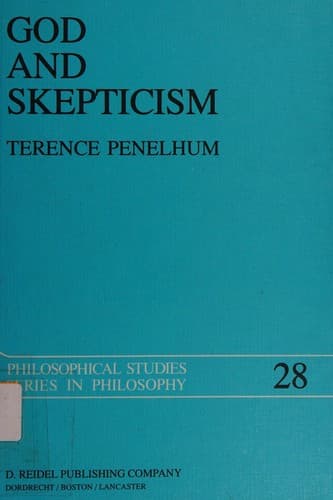
God and Skepticism
الله والشك
Dieu et le scepticisme
Editorial summary
This monograph examines the complex relationship between skeptical philosophy and religious belief, arguing that while skepticism poses significant challenges to theistic claims, it does not necessarily lead to atheism and may paradoxically support certain forms of faith. Penelhum traces the historical development of skeptical arguments about God from ancient philosophy through the modern period, demonstrating how different skeptical strategies have shaped theological discourse.
The work begins by distinguishing between methodological skepticism, which questions the grounds for religious knowledge claims, and substantive skepticism, which doubts the content of religious beliefs themselves. Penelhum argues that the former, exemplified by Descartes' method of doubt, can actually strengthen theistic conviction by forcing believers to articulate more rigorous foundations for their faith. The latter form, however, presents more serious challenges by questioning whether any religious claims can meet reasonable epistemic standards.
Central to Penelhum's analysis is his treatment of Hume's skeptical critique of natural theology. He demonstrates how Hume's arguments against the design argument and miracles represent a watershed moment in the God debate, effectively undermining traditional philosophical proofs while stopping short of dogmatic atheism. Penelhum suggests that Hume's position exemplifies a coherent skeptical stance that neither affirms nor denies God's existence but questions our capacity to know either way.
The monograph's most significant contribution lies in its exploration of fideism as a response to skepticism. Penelhum examines how thinkers like Pascal and Kierkegaard embrace skeptical critiques of rational theology while maintaining that faith operates in a different epistemic domain. He argues that this move, while philosophically coherent, comes at the cost of severing religious belief from rational discourse, potentially isolating faith from critical examination.
Penelhum concludes by assessing contemporary attempts to navigate between skepticism and belief, including reformed epistemology and pragmatic approaches to religious truth. He maintains that while skepticism remains a formidable challenge to confident theistic assertion, it equally undermines confident atheistic denial. The work thus presents skepticism not as an enemy of religion but as a philosophical position that demands intellectual humility from all participants in the God debate, whether believers, atheists, or agnostics.
Argument formulations engaged
Related works
Penelhum, Terence (1983). God and Skepticism. Springer.
@book{god-and-skepticism-1983,
  author    = {Penelhum, Terence},
  title     = {God and Skepticism},
  year      = {1983},
  publisher = {Springer},
  url       = {https://god-database.com/en/works/god-and-skepticism-1983}
}