
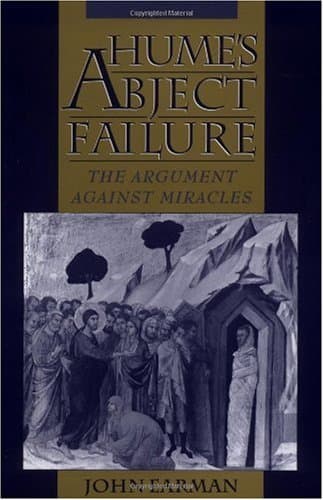
Hume's Abject Failure: The Argument Against Miracles
فشل هيوم المشين: الحجة ضد المعجزات
L'échec abject de Hume : L'argument contre les miracles
Editorial summary
John Earman's monograph mounts a comprehensive philosophical assault on David Hume's celebrated argument against miracles, contending that Hume's reasoning fails on multiple fronts despite its enduring influence in philosophy of religion. The work represents a significant intervention in debates about divine action, religious epistemology, and the rationality of belief in supernatural events.
Earman systematically dismantles Hume's argument from Section 10 of the Enquiry Concerning Human Understanding, which claims that testimony for miracles can never outweigh the evidence of natural law. The author employs rigorous probabilistic analysis, drawing on Bayesian confirmation theory to expose fundamental flaws in Hume's reasoning. He demonstrates that Hume's argument relies on questionable assumptions about probability, testimony, and the nature of evidence that do not withstand mathematical scrutiny.
The monograph reveals how Hume conflates different types of probability claims and makes illegitimate moves from premises about general human experience to conclusions about specific testimonial cases. Earman shows that Hume's famous maxim that no testimony is sufficient to establish a miracle unless its falsehood would be more miraculous than the event itself contains a logical circularity that undermines its force. Through careful analysis of historical examples and hypothetical scenarios, the work illustrates how reasonable people could rationally believe miracle reports under certain evidential conditions.
Beyond technical criticism, Earman situates Hume's argument within its eighteenth-century context, examining how Enlightenment prejudices about religion shaped its reception. He argues that philosophers have given Hume's argument undeserved deference, allowing rhetorical flourishes to substitute for logical rigor. The monograph engages with contemporary defenders of Hume, including J.L. Mackie and Antony Flew, showing how their reformulations fail to rescue the core argument from its fundamental defects.
Earman's contribution extends beyond historical criticism to offer positive proposals about how to evaluate miracle claims using formal epistemology. While not defending any particular miracle claim, he establishes that categorical dismissal of miraculous events based on Humean reasoning lacks philosophical justification. The work challenges both religious skeptics who invoke Hume as definitive and believers who concede too much to his critique. By demonstrating the failure of one of natural theology's most influential attacks, Earman's monograph reopens philosophical space for serious consideration of divine action in the world.
Argument formulations engaged
Related works
Earman, John (2000). Hume's Abject Failure: The Argument Against Miracles. Oxford University Press, USA.
@book{humes-abject-failure-the-argument-agains,
  author    = {Earman, John},
  title     = {Hume's Abject Failure: The Argument Against Miracles},
  year      = {2000},
  publisher = {Oxford University Press, USA},
  url       = {https://god-database.com/en/works/humes-abject-failure-the-argument-against-miracles-2000}
}