
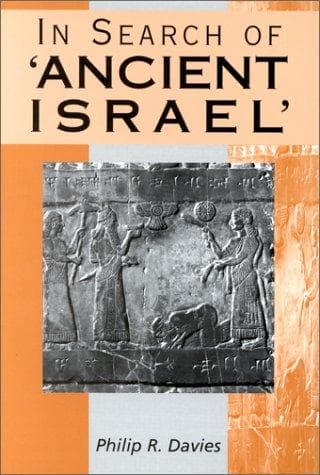
In Search of 'Ancient Israel'
في البحث عن إسرائيل القديمة
À la recherche d'« Israël antique »
Editorial summary
This monograph fundamentally challenges the historical reliability of biblical narratives and their use in reconstructing ancient Israel's past. Davies argues that "ancient Israel" as depicted in biblical texts is largely a literary construction rather than a historical reality, positioning himself against the mainstream biblical archaeology and historiography of his time. His central thesis contends that the Hebrew Bible emerged primarily during the Persian period (539-332 BCE) and reflects the ideological concerns of that era rather than preserving accurate memories of earlier periods.
Davies employs a minimalist historical methodology that demands independent archaeological and epigraphic evidence before accepting biblical claims as historical. He systematically examines the available extra-biblical evidence for ancient Israel and finds it remarkably sparse, particularly for the monarchic period traditionally dated to the 10th-9th centuries BCE. This approach directly confronts maximalist scholars who assume the basic historical reliability of biblical narratives unless definitively disproven.
The work's significance for discussions about God lies in its radical implications for religious authority and revelation. By arguing that biblical Israel is essentially a fictive creation of Persian-period scribes, Davies undermines traditional claims about divine action in history. If the exodus, conquest, and Davidic empire are literary inventions rather than historical events, then the theological interpretations built upon these narratives—including concepts of covenant, election, and divine providence—lose their historical grounding.
Davies distinguishes between three "Israels": historical Israel (the northern kingdom that existed until 722 BCE), biblical Israel (the literary construct in the Hebrew Bible), and ancient Israel (the scholarly reconstruction combining both). He argues that conflating these categories has led to circular reasoning, where biblical texts are used to interpret archaeological finds that are then claimed to verify the texts.
This methodological critique extends beyond historical reconstruction to challenge how scholars approach questions of ancient Israelite religion and theology. Davies suggests that what the Bible presents as ancient Yahwistic faith may actually represent post-exilic theological developments projected backwards. His work thus raises fundamental questions about the relationship between historical criticism and religious belief, making it a crucial contribution to debates about the factual basis of theistic claims and the nature of religious texts as historical sources.
Argument formulations engaged
Davies, Philip R. (1992). In Search of 'Ancient Israel'. Bloomsbury T&T Clark.
@book{in-search-of-ancient-israel-1992,
  author    = {Davies, Philip R.},
  title     = {In Search of 'Ancient Israel'},
  year      = {1992},
  publisher = {Bloomsbury T&T Clark},
  url       = {https://god-database.com/en/works/in-search-of-ancient-israel-1992}
}