
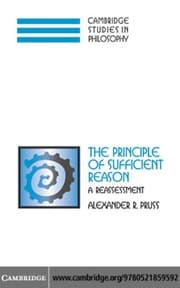
The Principle of Sufficient Reason
مبدأ السبب الكافي
Le Principe de raison suffisante
Alexander Pruss defends the Principle of Sufficient Reason (PSR) — the claim that every contingent fact has an explanation — and argues that PSR, properly formulated, supports the cosmological argument for the existence of a necessary being identified with God.
Editorial summary
This monograph presents a comprehensive defense of the Principle of Sufficient Reason (PSR), which holds that every contingent fact has an explanation. Pruss develops a sophisticated account that addresses longstanding objections while demonstrating the principle's central importance for rational inquiry and theistic argumentation. The work engages primarily with contemporary analytic philosophers who have rejected or restricted the PSR, including Peter van Inwagen, William Rowe, and Graham Oppy.
The study employs modal logic and possible worlds semantics to formulate precise versions of the PSR, distinguishing between explanations of contingent facts and necessary truths. Pruss argues that skepticism about the PSR undermines ordinary empirical reasoning and scientific practice, since these depend on the assumption that observable phenomena have explanations. He demonstrates how denying the PSR leads to radical skepticism about induction, perception, and even basic logical inference.
Central to Pruss's project is addressing the modal fatalism objection, which claims the PSR entails that all truths are necessary. Through careful modal analysis, he shows this objection rests on a conflation between the necessity of explained facts and the necessity of the conditional relationship between explanandum and explanans. The work develops a libertarian account of free will compatible with the PSR, arguing that agent-causal explanations can terminate explanatory regresses without violating the principle.
The monograph's most significant contribution to natural theology lies in its rehabilitation of cosmological arguments. Pruss demonstrates how the PSR directly supports arguments from contingency for a necessary being, while also strengthening certain ontological arguments that rely on the explicability of possibilities. He argues that the conjunction of all contingent facts requires a necessary being as its ultimate explanation, and that this being must possess the attributes traditionally ascribed to God.
Throughout, Pruss engages charitably with naturalistic alternatives, examining whether brute facts, infinite regresses, or circular explanations might satisfy explanatory demands without invoking God. He argues these alternatives either violate the PSR or fail to provide genuine explanations. The work stands as perhaps the most thorough contemporary defense of a principle that has been central to philosophical theology since Leibniz, reinvigorating classical theistic arguments through the tools of contemporary modal logic.
Structured analysis
Argument formulations engaged
Related works
Pruss, Alexander R. The Principle of Sufficient Reason. Cambridge University Press.
@book{the-principle-of-sufficient-reason,
  author    = {Pruss, Alexander R.},
  title     = {The Principle of Sufficient Reason},
  year      = {n.d.},
  publisher = {Cambridge University Press},
  url       = {https://god-database.com/en/works/the-principle-of-sufficient-reason}
}