
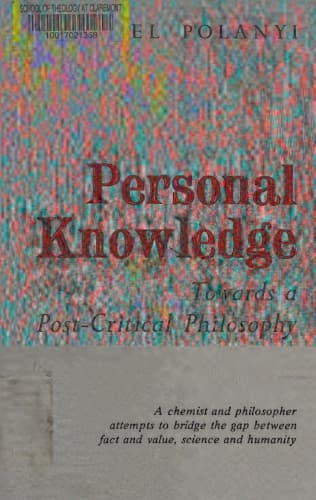
Personal Knowledge: Towards a Post-Critical Philosophy
المعرفة الشخصية: نحو فلسفة ما بعد نقدية
Connaissance personnelle : Vers une philosophie post-critique
Editorial summary
This landmark work challenges the prevailing ideal of wholly objective, impersonal knowledge that dominated twentieth-century philosophy of science. Polanyi, drawing on his experience as a physical chemist, argues that all knowledge, including scientific knowledge, necessarily involves personal participation and commitment. The book develops a comprehensive epistemology that acknowledges the role of the knower's personal judgment, tacit awareness, and fiduciary framework in the acquisition and validation of knowledge.
Central to Polanyi's argument is the concept of "tacit knowledge" - the idea that humans know more than they can explicitly articulate. He demonstrates that scientific discovery relies on skills, intuitions, and commitments that cannot be fully formalized or mechanized. The scientist's personal participation, far from being a contamination to be eliminated, constitutes an indispensable element in the pursuit of truth. Polanyi critiques the false ideal of complete objectivity, showing how it leads to self-contradiction and nihilism when pursued to its logical conclusion.
The work directly confronts logical positivism and the broader project of reducing all genuine knowledge to explicit, testable propositions. Against thinkers like Carnap and the Vienna Circle, Polanyi argues that the attempt to eliminate all personal elements from knowledge undermines the very foundations of science itself. He demonstrates that scientific practice depends on inherited traditions, apprenticeship, and communities of inquiry that transmit tacit knowledge through personal contact and shared commitment.
Regarding ultimate questions, Polanyi's epistemology creates space for religious knowledge by challenging the restriction of legitimate knowledge to empirically verifiable claims. He argues that the personal dimension of knowing applies to all domains of human understanding, including moral, aesthetic, and religious insights. The book suggests that religious faith, like scientific belief, involves a responsible commitment that transcends what can be proven through explicit reasoning alone.
Polanyi's post-critical philosophy offers a middle path between dogmatic objectivism and relativistic subjectivism. By showing that all knowledge involves personal participation within a tradition, he provides intellectual grounds for taking religious commitments seriously as potential sources of genuine knowledge. His work has profoundly influenced subsequent discussions in philosophy of science, theology, and interdisciplinary dialogue about the relationship between scientific and religious ways of knowing.
Argument formulations engaged
Related works
Polanyi, Michael (1958). Personal Knowledge: Towards a Post-Critical Philosophy. University Of Chicago Press.
@book{personal-knowledge-towards-a-post-critic,
  author    = {Polanyi, Michael},
  title     = {Personal Knowledge: Towards a Post-Critical Philosophy},
  year      = {1958},
  publisher = {University Of Chicago Press},
  url       = {https://god-database.com/en/works/personal-knowledge-towards-a-post-critical-philosophy-1958}
}