
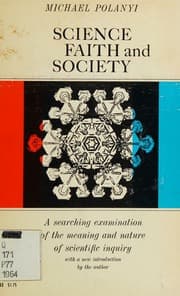
Science, Faith and Society
العلم والإيمان والمجتمع
Science, foi et société
Editorial summary
This work examines the relationship between scientific knowledge and religious belief, arguing that both domains share fundamental epistemological structures rooted in personal commitment and tacit knowledge. Polanyi challenges the prevailing positivist view that science operates through purely objective, detached observation, proposing instead that scientific discovery requires acts of faith analogous to religious belief.
The author develops his argument through careful analysis of how scientists actually work, demonstrating that scientific knowledge depends upon personal judgment, intuitive leaps, and commitment to unproven assumptions. He contends that the scientific community functions much like a religious community, bound together by shared beliefs, authoritative traditions, and mutual trust. This parallel extends to the transmission of knowledge, where both science and religion rely on master-apprentice relationships and the acceptance of testimony from trusted authorities.
Polanyi's central thesis challenges the sharp distinction between scientific rationality and religious faith that dominated mid-twentieth century thought. He argues that all knowledge, including scientific knowledge, involves what he terms "fiduciary" elements - components that must be accepted on faith before they can be verified or even properly understood. The scientist's belief in the intelligibility of nature, the reliability of experimental methods, and the value of truth-seeking parallels the religious believer's fundamental commitments.
The work engages critically with logical positivism and scientific materialism, particularly as articulated by members of the Vienna Circle. Against their reductionist program, Polanyi maintains that the personal coefficient in knowing cannot be eliminated without destroying knowledge itself. His analysis suggests that attempts to create a purely objective science free from belief commitments are not only impossible but intellectually dishonest.
This contribution to the God debate operates indirectly, never arguing explicitly for theism but undermining the epistemological foundations of scientific atheism. By showing that science itself depends upon faith-like commitments, Polanyi removes one of the primary weapons in the arsenal of those who would dismiss religious belief as inherently irrational. His work suggests that the conflict between science and religion rests on false premises about the nature of both enterprises. The implications extend beyond philosophy of science to fundamental questions about how humans acquire and validate knowledge, whether scientific or religious.
Argument formulations engaged
Related works
Polanyi, Michael (1946). Science, Faith and Society. University of Chicago Press.
@book{science-faith-and-society-1946,
  author    = {Polanyi, Michael},
  title     = {Science, Faith and Society},
  year      = {1946},
  publisher = {University of Chicago Press},
  url       = {https://god-database.com/en/works/science-faith-and-society-1946}
}