
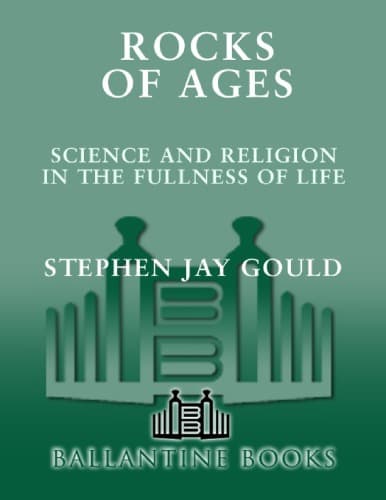
Rocks of Ages: Science and Religion in the Fullness of Life
صخور العصور: العلم والدين في ملء الحياة
Roches des âges : science et religion dans la plénitude de la vie
Editorial summary
This monograph presents Stephen Jay Gould's influential framework for understanding the relationship between science and religion through his principle of "non-overlapping magisteria" (NOMA). Gould argues that science and religion constitute distinct domains of teaching authority that address fundamentally different aspects of human experience and therefore cannot be in genuine conflict. Science covers the empirical realm of facts and theories about the natural world, while religion deals with questions of ultimate meaning and moral value.
Gould develops this thesis against two opposing positions he finds equally problematic. First, he challenges scientific materialists who claim that science can and should address all questions traditionally reserved for religion, including ethics and meaning. Second, he criticizes religious fundamentalists who attempt to derive empirical claims about the natural world from sacred texts or theological principles. Both positions, Gould contends, commit the error of conflating distinct magisteria and thereby generate unnecessary conflict.
The work draws extensively from historical examples to illustrate how apparent conflicts between science and religion often arise from category mistakes rather than genuine incompatibility. Gould examines cases ranging from Galileo's confrontation with the Catholic Church to contemporary debates over evolution and creationism. He argues that proper understanding of disciplinary boundaries would dissolve most supposed conflicts. When religion makes factual claims about nature or science ventures pronouncements on meaning and morality, each exceeds its legitimate domain.
Gould's approach reflects his commitment to both scientific naturalism and respect for religious traditions. As a paleontologist and evolutionary biologist, he firmly defends the autonomy of scientific inquiry while acknowledging that science cannot address all meaningful human questions. The NOMA principle thus serves as a diplomatic solution that preserves the integrity of both domains without requiring their synthesis or the subordination of one to the other.
The monograph's significance lies in its attempt to provide a principled framework for science-religion dialogue that avoids both reductionism and conflation. While critics have challenged whether the magisteria can be as neatly separated as Gould suggests, his formulation remains influential in discussions about the proper relationship between scientific and religious ways of knowing. The work represents a notable intervention by a prominent scientist in debates typically dominated by theologians and philosophers.
Argument formulations engaged
Related works
Gould, Stephen Jay (1999). Rocks of Ages: Science and Religion in the Fullness of Life.
@book{rocks-of-ages-science-and-religion-in-th,
  author    = {Gould, Stephen Jay},
  title     = {Rocks of Ages: Science and Religion in the Fullness of Life},
  year      = {1999},
  url       = {https://god-database.com/en/works/rocks-of-ages-science-and-religion-in-the-fullness-of-life-1999}
}