
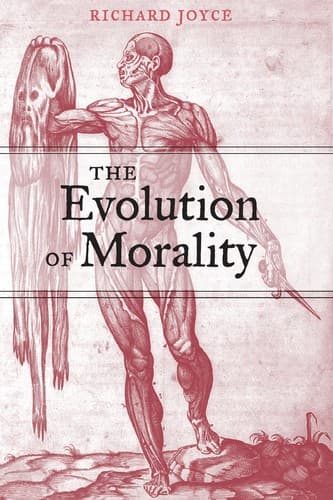
The Evolution of Morality
تطور الأخلاق
L'Évolution de la Moralité
Editorial summary
Joyce's monograph presents a comprehensive evolutionary account of human morality that carries significant implications for theistic ethics and religious explanations of moral phenomena. The work develops a genealogical argument tracing moral cognition to evolutionary pressures, ultimately defending what Joyce terms an "error theory" about moral discourse. This position holds that while humans universally engage in moral thinking and speaking, all positive moral claims are systematically false because they refer to properties that do not exist in reality.
The argument proceeds through careful examination of how natural selection could have favored the development of moral emotions, concepts, and linguistic practices without requiring the existence of objective moral facts. Joyce demonstrates how reciprocal altruism, kin selection, and social cooperation pressures would have made moral thinking adaptive for human ancestors. Creatures who experienced guilt, indignation, and moral approval would have been better positioned to navigate complex social environments and maintain beneficial cooperative relationships.
Central to Joyce's project is distinguishing between the usefulness of moral beliefs and their truth. He argues that evolution would have selected for moral believers regardless of whether moral facts exist, just as it might select for religious believers if such beliefs promoted survival and reproduction. This naturalistic explanation directly challenges divine command theories and other theistic metaethical positions that ground morality in God's nature or will.
Joyce engages extensively with both philosophical and empirical literature, drawing on primatology, developmental psychology, and anthropology to support his evolutionary narrative. He addresses objections from moral realists who argue that evolutionary origins do not necessarily undermine moral truth, maintaining that the best explanation for moral phenomenology requires no appeal to moral facts. The work also considers whether his error theory is self-defeating or practically untenable.
The monograph's significance for debates about God lies in its systematic challenge to arguments from morality for theism. If moral phenomena can be fully explained through evolutionary processes, and if moral discourse involves systematic error rather than tracking divine commands or objective values, then a major support for theistic worldviews is undermined. Joyce's careful analysis forces religious thinkers to confront whether naturalistic explanations of morality are more parsimonious than supernatural ones.
Argument formulations engaged
Related works
Joyce, Richard (2006). The Evolution of Morality.
@book{the-evolution-of-morality-2006,
  author    = {Joyce, Richard},
  title     = {The Evolution of Morality},
  year      = {2006},
  url       = {https://god-database.com/en/works/the-evolution-of-morality-2006}
}