
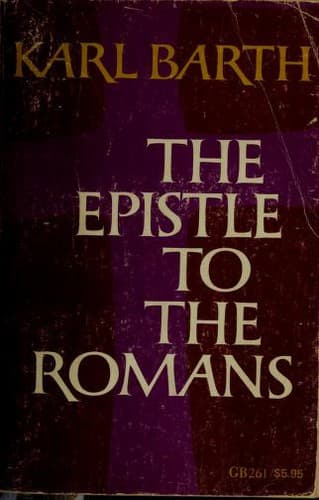
The Epistle to the Romans
الرسالة إلى الرومان
L'Épître aux Romains
Editorial summary
Karl Barth's commentary on Romans represents a watershed moment in twentieth-century theology, fundamentally reshaping Protestant discourse about divine revelation and human knowledge of God. Writing against the liberal Protestant tradition that dominated German theology since Schleiermacher, Barth argues that Romans demonstrates the absolute qualitative distinction between God and humanity, rejecting any natural theology that would ground knowledge of God in human experience or reason.
The commentary advances a dialectical method that emphasizes the crisis of human existence before the wholly Other. Barth interprets Paul's epistle as proclaiming that God remains utterly transcendent, knowable only through God's own self-revelation in Jesus Christ. This revelation judges all human religious endeavors, including Christianity itself when it becomes merely another human system. Against the nineteenth-century confidence in religious progress and cultural Christianity, Barth reads Romans as announcing God's No to every human attempt at self-justification, followed by God's Yes in Christ alone.
Barth's approach directly challenges both liberal theology's anthropocentric starting point and Roman Catholic natural theology. Where liberals like Harnack sought to extract timeless religious truths from historical criticism, Barth insists that God's Word confronts humanity as a perpetual scandal that cannot be domesticated by historical method. Against Catholic scholasticism's confidence in analogia entis (analogy of being between creation and Creator), Barth proposes analogia fidei (analogy of faith), maintaining that only faith responding to revelation provides genuine theological knowledge.
The work's significance extends beyond technical theology. Written in the shadow of World War 1's devastation, Barth's Romans commentary articulates a theology of crisis that resonated with European intellectuals disillusioned with cultural optimism. His emphasis on divine sovereignty and judgment would later inform the Confessing Church's resistance to Nazi ideology. The commentary establishes the methodological foundations for Barth's subsequent Church Dogmatics and catalyzes the neo-orthodox movement that dominated Protestant theology through the mid-twentieth century.
By relocating theology's starting point from human religious consciousness to God's self-revelation, Barth's Romans commentary reconfigures the modern debate about God's knowability. It argues that the question is not whether humans can discover God through reason or experience, but whether they will acknowledge the God who addresses them in judgment and grace through Scripture's witness to Christ.
Argument formulations engaged
Related works
Barth, Karl (1933). The Epistle to the Romans. Oxford University Press, USA.
@book{the-epistle-to-the-romans-1933,
  author    = {Barth, Karl},
  title     = {The Epistle to the Romans},
  year      = {1933},
  publisher = {Oxford University Press, USA},
  url       = {https://god-database.com/en/works/the-epistle-to-the-romans-1933}
}