
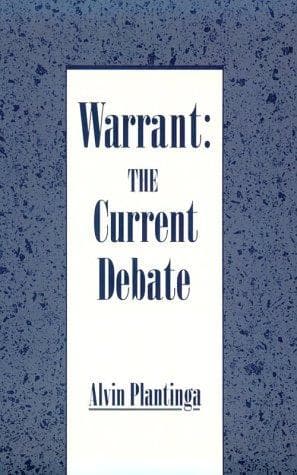
Warrant: The Current Debate
الضمان: النقاش الحالي
Garantie : Le débat actuel
Editorial summary
This monograph constitutes the second volume of Plantinga's trilogy on warrant, representing a comprehensive engagement with contemporary epistemology and its implications for religious belief. The work systematically examines and critiques major twentieth-century theories of warrant—that property which distinguishes mere true belief from knowledge—while laying groundwork for Plantinga's own proper functionalist account.
Plantinga organizes his analysis around four dominant approaches to warrant in contemporary epistemology. First, he examines classical internalist theories, including foundationalism and coherentism, demonstrating their inability to adequately explain what transforms true belief into knowledge. He argues that purely internal factors accessible to consciousness cannot sufficiently account for warrant. Second, he critiques deontological conceptions that ground warrant in epistemic duty-fulfillment, showing how such approaches fail to connect epistemic responsibility with truth-conduciveness. Third, he addresses reliabilist externalism, acknowledging its insights while identifying critical weaknesses in standard formulations. Fourth, he examines virtue epistemology, finding it ultimately reducible to other approaches.
The philosophical significance of this project extends beyond technical epistemology to fundamental questions about rational belief in God. By demonstrating the inadequacy of internalist constraints on knowledge, Plantinga challenges evidentialist objections to theistic belief that demand consciously accessible evidence or arguments. His critique of deontological approaches undermines the charge that believers violate epistemic duties by maintaining faith without sufficient evidence. The work thus serves as philosophical preparation for arguing that belief in God can possess warrant without depending on arguments or evidence.
Plantinga's methodology combines careful analytical philosophy with broad historical awareness, engaging figures from Descartes and Locke through contemporary epistemologists like Goldman, BonJour, and Sosa. He employs thought experiments and counterexamples to expose the limitations of each theory, particularly their inability to handle Gettier-type cases or explain the connection between justification and truth.
The monograph's importance lies not merely in its negative critique but in its systematic clearing of philosophical ground. By demonstrating that neither internalism, deontology, simple reliabilism, nor virtue epistemology adequately captures warrant, Plantinga prepares readers for his positive proposal: that warrant derives from proper function of cognitive faculties operating in appropriate environments according to design plans aimed at truth. This framework, fully developed in the trilogy's final volume, provides theoretical space for warranted religious belief arising from divine design of human cognitive faculties.
Argument formulations engaged
Related works
Plantinga, Alvin (1993). Warrant: The Current Debate. Oxford University Press.
@book{warrant-the-current-debate-1993,
  author    = {Plantinga, Alvin},
  title     = {Warrant: The Current Debate},
  year      = {1993},
  publisher = {Oxford University Press},
  url       = {https://god-database.com/en/works/warrant-the-current-debate-1993}
}