
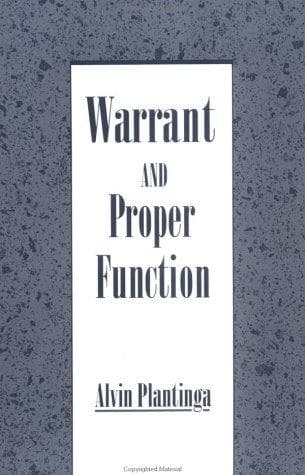
Warrant and Proper Function
الضمان والوظيفة الصحيحة
Garantie et fonction propre
Editorial summary
Alvin Plantinga's Warrant and Proper Function presents the second installment of his influential trilogy on epistemology, developing a comprehensive theory of knowledge that carries significant implications for religious belief. The work advances Plantinga's central thesis that warrant—that property which distinguishes knowledge from mere true belief—consists in a belief being produced by cognitive faculties functioning properly in an appropriate environment according to a design plan successfully aimed at truth.
This volume builds upon Plantinga's critique of internalist epistemology presented in Warrant: The Current Debate, offering a positive externalist account that grounds knowledge in the proper functioning of our cognitive apparatus. Plantinga argues that traditional approaches to epistemology, particularly those emphasizing justification through evidence or coherence, fail to capture what genuinely converts true belief into knowledge. His proper functionalism contends that beliefs possess warrant when they result from faculties operating as they should, in environments for which they were designed, according to a plan oriented toward producing true beliefs.
The religious significance of this epistemological framework emerges through Plantinga's treatment of the design plan concept. While the notion of proper function might initially appear neutral regarding theism, Plantinga argues that it ultimately requires a purposive or teleological understanding that naturalistic evolution cannot adequately provide. He contends that evolutionary naturalism faces an insurmountable difficulty: if our cognitive faculties evolved merely for survival rather than truth-tracking, we have no reason to trust their deliverances about metaphysical or theoretical matters, including the truth of naturalism itself.
This evolutionary argument against naturalism represents a crucial component of Plantinga's broader philosophical project. By establishing that reliable cognitive faculties require design aimed at truth, he creates intellectual space for theistic belief as epistemically warranted. The work thus challenges the presumption that religious belief lacks proper epistemic credentials, suggesting instead that naturalism itself suffers from a crippling self-referential problem.
Plantinga's contribution reshapes debates about religious knowledge by shifting focus from evidential demands to questions about cognitive design and reliability. His proper functionalism offers theists a sophisticated response to evidentialist challenges while mounting an offensive against naturalistic epistemology. The work's influence extends beyond philosophy of religion, affecting discussions in epistemology, philosophy of mind, and metaphysics regarding the nature of knowledge, mental content, and the relationship between evolution and truth.
Argument formulations engaged
Related works
Plantinga, Alvin (1993). Warrant and Proper Function. Oxford University Press.
@book{warrant-and-proper-function-1993,
  author    = {Plantinga, Alvin},
  title     = {Warrant and Proper Function},
  year      = {1993},
  publisher = {Oxford University Press},
  url       = {https://god-database.com/en/works/warrant-and-proper-function-1993}
}