
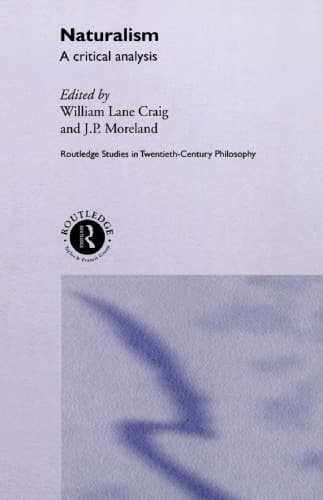
Naturalism: A Critical Analysis
الطبيعانية: تحليل نقدي
Naturalisme : Une Analyse Critique
Editorial summary
This volume presents a sustained philosophical critique of naturalism, the view that reality consists solely of physical entities operating according to natural laws. Moreland assembles contributions from various philosophers who challenge naturalism's coherence and explanatory adequacy across multiple domains, positioning the work as a defense of theistic alternatives to materialist worldviews.
The collection examines naturalism's philosophical foundations and alleged failures through several interconnected arguments. Contributors analyze the self-referential problems inherent in naturalistic epistemology, arguing that if human cognitive faculties evolved merely for survival rather than truth-tracking, naturalism undermines its own rational justification. This evolutionary argument against naturalism features prominently, suggesting that theistic accounts better explain the reliability of human reason.
Several chapters address consciousness and mental phenomena, contending that naturalism cannot adequately account for qualia, intentionality, or the unity of conscious experience. The authors argue that irreducible mental properties point toward non-physical aspects of reality that naturalism systematically excludes. Related discussions examine moral realism, maintaining that objective moral values and duties require grounding in a transcendent source rather than emerging from purely material processes.
The volume engages contemporary naturalist philosophers directly, responding to arguments from figures like Quine, Dennett, and the Churchlands. Contributors employ analytic philosophical methods to expose what they view as conceptual confusions and explanatory gaps in naturalistic accounts of knowledge, consciousness, and value. The work situates itself within the broader revival of theistic philosophy in the late twentieth century, challenging the assumption that scientific progress necessarily supports naturalistic metaphysics.
Moreland's editorial framework unifies these diverse critiques around the central thesis that naturalism fails as a comprehensive worldview. The collection argues that phenomena like consciousness, rationality, and morality serve as "recalcitrant facts" that resist naturalistic reduction and point toward theistic explanation. While acknowledging naturalism's influence in contemporary philosophy and science, the volume contends that its limitations become apparent when addressing fundamental questions about mind, meaning, and morality.
This work contributes to philosophy of religion by providing sophisticated arguments against the naturalistic worldview that often grounds atheistic positions. Rather than offering direct arguments for God's existence, it pursues an indirect strategy of undermining naturalism's credibility, thereby creating intellectual space for theistic alternatives.
Argument formulations engaged
Related works
Moreland, J. P. (2000). Naturalism: A Critical Analysis. Routledge.
@book{naturalism-a-critical-analysis-2000,
  author    = {Moreland, J. P.},
  title     = {Naturalism: A Critical Analysis},
  year      = {2000},
  publisher = {Routledge},
  url       = {https://god-database.com/en/works/naturalism-a-critical-analysis-2000}
}