
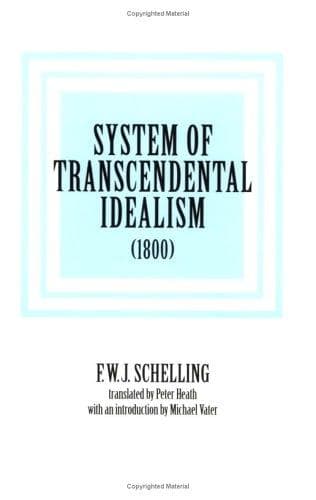
System of Transcendental Idealism
نظام المثالية المتعالية
Système de l'idéalisme transcendantal
Editorial summary
Schelling's System of Transcendental Idealism represents a pivotal contribution to post-Kantian philosophy that profoundly reshapes the relationship between divine consciousness and human self-awareness. Writing at the height of German Idealism's creative ferment in 1800, Schelling develops a systematic account of how absolute consciousness progressively manifests itself through nature and human history, culminating in aesthetic intuition as the highest form of knowledge.
The work advances a distinctive philosophical theology that dissolves traditional boundaries between God, nature, and mind. For Schelling, what theology calls God and philosophy names the Absolute constitutes neither a transcendent being nor a mere concept, but rather the self-realizing identity underlying both subjective consciousness and objective nature. This position challenges both orthodox theism, which maintains God's essential separateness from creation, and mechanistic materialism, which reduces reality to blind natural forces. Against Fichte's subjective idealism, which grounds everything in the ego's self-positing activity, Schelling insists on nature's independent reality as the Absolute's unconscious self-expression.
Central to Schelling's argument is his genetic method, which traces consciousness through ascending stages of development from unconscious nature through organic life to human self-awareness and finally artistic creation. Each stage represents a higher synthesis of subject and object, freedom and necessity. The System demonstrates how theoretical philosophy reaches an impasse when attempting to grasp the Absolute conceptually, necessitating a turn to aesthetic intuition where finite and infinite momentarily coincide. Art thus assumes a quasi-religious function as the organon of philosophy, revealing what discursive reason cannot adequately express.
The theological implications prove far-reaching. Schelling's identification of God with the self-developing Absolute anticipates later process theology while his emphasis on unconscious divine activity in nature prefigures depth psychology's insights. His treatment of evil as a necessary moment in the Absolute's self-realization sparked intense debate, particularly with Hegel. The work's influence extends through Coleridge to English Romanticism and American Transcendentalism, shaping alternative spiritualities that seek divinity within natural and cultural processes rather than supernatural intervention. Contemporary discussions of panentheism and emergent complexity often unknowingly echo Schelllingian themes, confirming this work's enduring relevance for negotiating between religious intuition and philosophical reflection.
Argument formulations engaged
Related works
Schelling, Friedrich (1800). System of Transcendental Idealism. University of Virginia Press.
@book{system-of-transcendental-idealism-1800,
  author    = {Schelling, Friedrich},
  title     = {System of Transcendental Idealism},
  year      = {1800},
  publisher = {University of Virginia Press},
  url       = {https://god-database.com/en/works/system-of-transcendental-idealism-1800}
}