
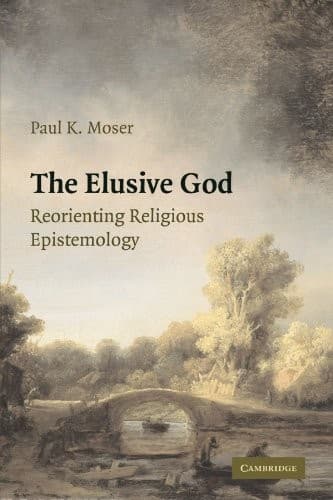
The Elusive God: Reorienting Religious Epistemology
الإله المراوغ: إعادة توجيه نظرية المعرفة الدينية
Le Dieu insaisissable : Réorienter l'épistémologie religieuse
Editorial summary
Moser's monograph presents a distinctive approach to religious epistemology that challenges both traditional natural theology and skeptical critiques of theistic belief. The work develops an account of "purposively available divine evidence" that reframes the epistemological debate about God's existence by arguing that the kind of evidence one should expect from a morally perfect God differs radically from the evidence sought by conventional philosophical arguments.
Central to Moser's thesis is the claim that a perfectly loving God would not provide evidence that merely satisfies intellectual curiosity or establishes propositional knowledge. Instead, such a God would offer "kardiatheology" - evidence aimed at moral and spiritual transformation of the human heart (kardia). This evidence becomes available only to those willing to submit their will to divine purposes, explaining why sincere seekers may find compelling evidence while others encounter divine hiddenness. Moser argues that God remains "elusive" precisely to avoid coercing belief in ways that bypass moral transformation.
The work systematically critiques both sides of the traditional debate. Against natural theology, Moser contends that arguments from design, cosmology, or ontology seek the wrong kind of evidence - spectator evidence that allows humans to remain morally unchanged. Against religious skeptics, he argues they employ inadequate epistemological standards by demanding publicly observable evidence that a morally perfect God would have reason to withhold. The book engages extensively with contemporary epistemologists and philosophers of religion, including William Alston, Alvin Plantinga, and J.L. Schellenberg, while drawing on biblical theology, particularly Pauline texts, to support its constructive proposals.
Moser introduces several technical distinctions that prove crucial to his argument. He differentiates between "spectator evidence" (accessible to neutral observers) and "authoritative evidence" (requiring volitional engagement), and between "natural theology" (arguing from creation to creator) and "kardiatheology" (focusing on divine-human transformation). These distinctions enable him to articulate why traditional approaches fail to capture how a morally perfect God would relate to creatures.
The monograph's significance lies in its reframing of religious epistemology around divine purposes rather than human epistemic goals. By arguing that divine hiddenness serves redemptive purposes, Moser offers theists a response to evidential challenges while providing a philosophical framework that takes seriously the transformative dimensions of religious experience. His work has influenced subsequent discussions about the relationship between evidence, volition, and religious knowledge.
Argument formulations engaged
Related works
Moser, Paul K. (2008). The Elusive God: Reorienting Religious Epistemology. Cambridge University Press.
@book{the-elusive-god-reorienting-religious-ep,
  author    = {Moser, Paul K.},
  title     = {The Elusive God: Reorienting Religious Epistemology},
  year      = {2008},
  publisher = {Cambridge University Press},
  url       = {https://god-database.com/en/works/the-elusive-god-reorienting-religious-epistemology-2008}
}